Zomato Restaurant Data Extraction : Turning Public Food Data into Clear Business Decisions
Restaurants rarely fail because of food quality.
They struggle because decisions are made without visibility.
In today’s competitive food delivery ecosystem, platforms like Zomato generate an enormous amount of restaurant-related data every day. Menu prices change, competitors launch offers, customer ratings shift, and demand patterns vary by location and time.
Yet, despite all this information being publicly visible, many restaurant teams still operate with limited clarity.
The issue isn’t the lack of data.
The issue is turning that data into something usable.
The Hidden Problem Behind Restaurant Decisions.
Most restaurant owners and operators rely on a mix of instinct, basic dashboards, and delayed reports. While this may work in the early stages, it becomes a limitation as competition increases.
Common challenges include:
- Not knowing why ratings suddenly drop
- Discovering competitor discounts too late
- Pricing menus without understanding local demand
- Reacting to trends instead of anticipating them
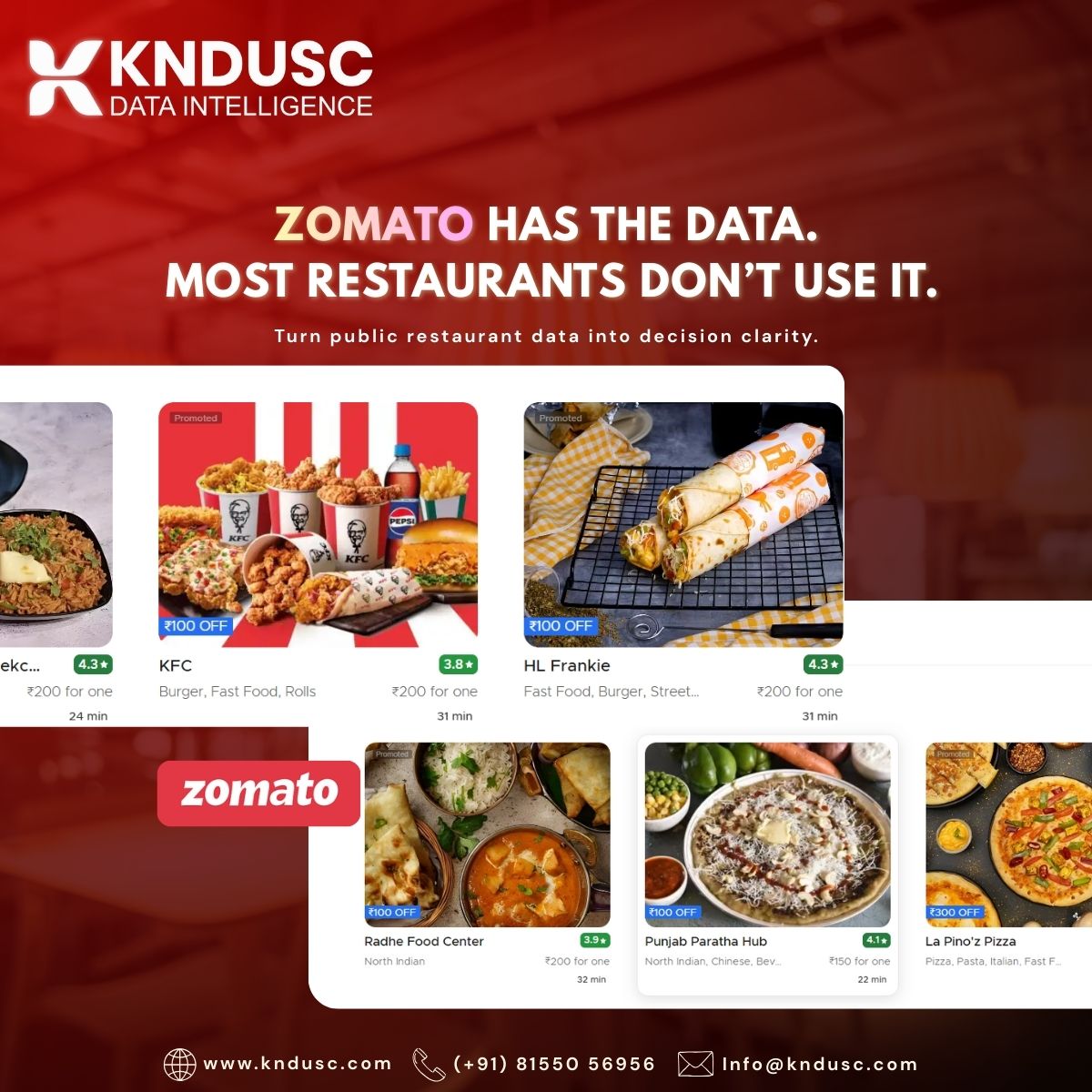
Zomato shows fragments of this information, but it does not connect the dots. Without structured insight, data remains scattered and difficult to act on.
This gap between available data and decision clarity is where growth slows down.
What Restaurant Teams Actually Want to Understand
- Which cuisines are gaining demand in a specific area?
- How are nearby competitors pricing similar dishes today?
- What patterns exist behind customer reviews and ratings?
- When do offers actually increase order volume?
- How do delivery times and availability impact performance?
All of this information exists on Zomato.
The challenge is extracting it in a structured and meaningful way.
Why Platform Dashboards Are Often Not Enough
Native dashboards are built for general visibility, not strategic analysis. They often:
- Aggregate data at a high level
- Limit historical comparisons
- Do not allow competitor benchmarking
- Lack customization for specific business goals
How Zomato Restaurant Data Extraction Helps
Zomato restaurant data extraction focuses on collecting publicly available information and organizing it into structured datasets that support decision-making.
This can include:
- Restaurant listings by location
- Menu items and pricing changes
- Customer ratings and review patterns
- Discounts and promotional activity
- Cuisine demand by area
- Delivery time and availability trends
When this data is cleaned, structured, and updated consistently, it becomes far more valuable than raw listings or screenshots.
It becomes a decision-support tool.
What Kind of Restaurant Data Can Be Extracted from Zomato
The data can include:
Restaurant identity details
Name, location, cuisine categories, outlet type, and service availability.
Menu and pricing information
Dish names, item categories, current prices, and visible pricing changes over time.
Offers and promotional activity
Active discounts, deal frequency, and promotional positioning across similar restaurants.
Customer ratings and review signals
Rating scores, review volume trends, and visible feedback patterns that indicate performance shifts.
Cuisine and category demand indicators
How different cuisines perform across locations and time periods.
Delivery and availability metrics
Estimated delivery times, service availability, and order readiness signals.
Competitive landscape insights
Side-by-side visibility of similar restaurants within the same area or category.
Location-level market signals
Area-specific restaurant density, pricing ranges, and competitive intensity.
Each dataset is structured to be usable, comparable, and scalable, making it easier to analyze trends instead of manually tracking changes.
What Businesses Can Do With Structured Zomato Data
- Plan menus based on real local demand
- Adjust pricing before revenue declines
- Identify the reasons behind rating fluctuations
- Benchmark performance against competitors
- Make informed expansion or optimization decisions
Our Perspective at KNDUSC
At KNDUSC, we believe data should simplify decisions — not complicate them.
Our focus is on transforming public restaurant data into structured, usable formats that teams can actually work with. We emphasize accuracy, consistency, and clarity so that insights are reliable and actionable.
The goal is not to overwhelm businesses with numbers, but to help them understand what the data is truly indicating.
Data Exists. Clarity Creates the Advantage.
Zomato already reflects what customers want, how competitors act, and where demand shifts occur. The missing piece is not access — it is structure and interpretation.
When restaurant teams move from intuition to insight, decisions become more confident, timely, and consistent.
If you’re exploring how structured Zomato restaurant data can support better pricing, menu planning, or competitive analysis, you can learn more about our approach or reach out to us whenever it makes sense.