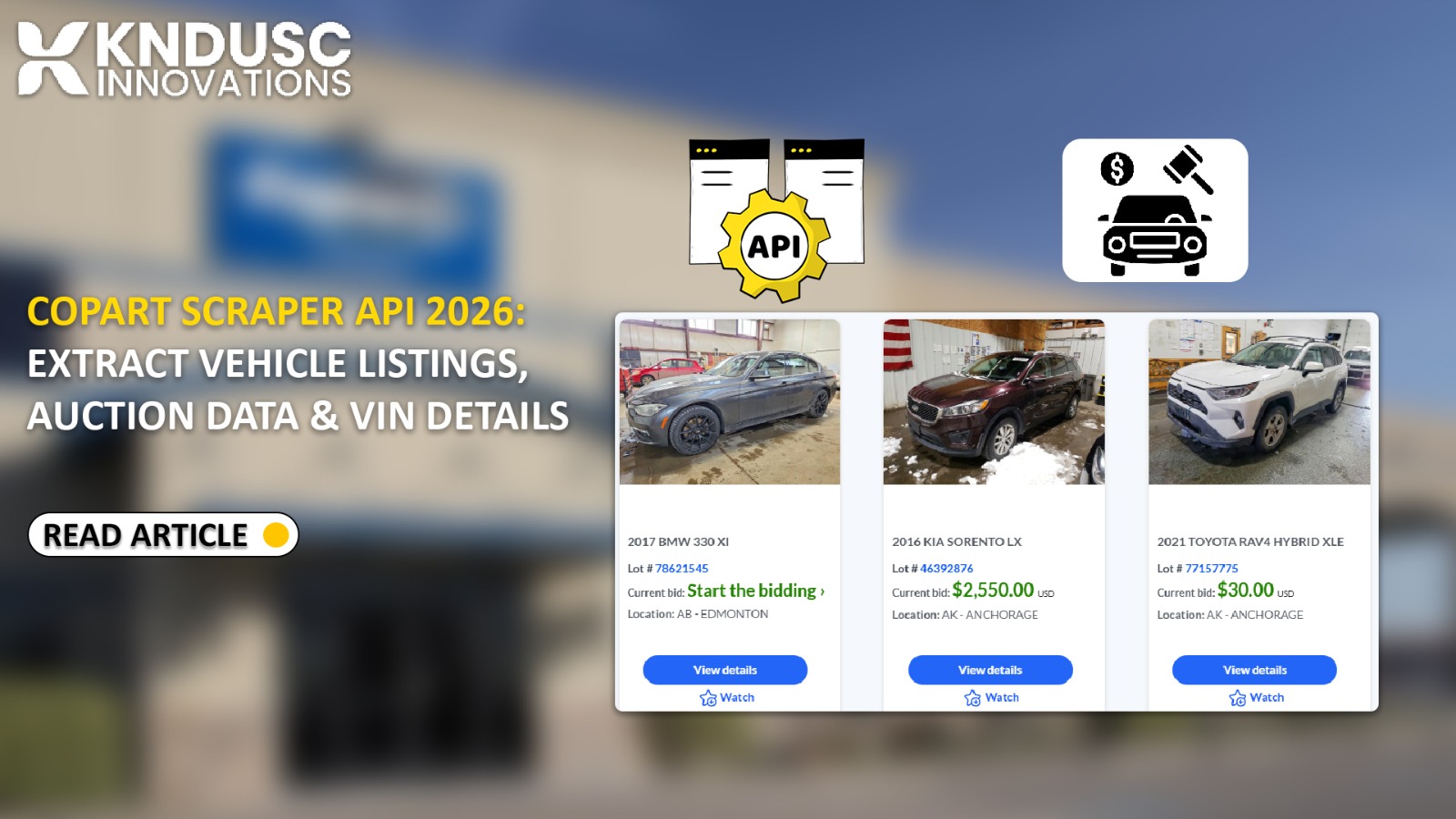
When working with vehicle auction platforms like Copart, accessing structured data can be challenging without the right tools. A Copart scraper API allows you to efficiently extract valuable information such as Copart auction data, vehicle listings, and real-time updates directly from the platform. Instead of manual browsing, developers and data analysts use a Copart scraper to automate data collection, making it easier to build datasets for research, pricing analysis, or automotive business insights.
With the help of a reliable Copart API, you can also retrieve detailed Copart VIN details, including vehicle history, damage reports, and auction results. This data is essential for car dealers, resellers, and data-driven businesses looking to analyze trends or identify profitable opportunities. By leveraging Copart data scraping techniques, you can unlock large-scale access to auction history, pricing patterns, and vehicle specifications, giving you a strong competitive edge in the automotive market.
What is Copart Data Scraping?
Copart data scraping is the process of automatically extracting vehicle auction information from Copart using tools, scripts, or a Copart scraper API. Instead of manually browsing thousands of listings, users can use web scraping techniques to collect structured data such as vehicle listings, auction results, pricing history, and Copart VIN details. This makes it much easier to analyze large volumes of auction data efficiently.
Many developers and businesses rely on how to scrape Copart auction data, Copart historical data scraping, and automated Copart data extraction tools to gather insights at scale. With the help of a Copart scraper, you can extract key information like vehicle condition, damage type, sale price, and bidding history. This type of data is especially useful for car dealers, data analysts, and automotive startups that need accurate and up-to-date auction data.
In simple terms, web scraping Copart vehicle listings allows you to turn unstructured website data into a usable dataset. Whether you're building a pricing model, tracking Copart auction history data, or creating your own Copart API, data scraping helps you unlock valuable insights that are otherwise difficult to access manually.
How the Copart Auction System Works (Complete Guide)
The auction system on Copart is designed to connect sellers (like insurance companies, dealers, and fleet owners) with buyers looking for vehicles at competitive prices. Each vehicle is listed with detailed information including images, condition reports, and Copart VIN details, allowing buyers to evaluate the car before placing a bid. Understanding how Copart auctions work step by step is essential if you plan to extract or analyze Copart auction data effectively.
Copart primarily operates through two types of auctions: pre-bid auctions and live online auctions. In the pre-bid phase, users can place early bids on vehicles before the live auction begins. Once the live auction starts, bidders compete in real-time, and the highest bid wins if it meets the seller’s reserve price. This process generates valuable Copart auction history data, including bid progression, final sale price, and auction outcomes all of which can be collected using a Copart scraper or Copart scraper API.
For those interested in how to scrape Copart auction data, understanding this auction flow is crucial. Each listing goes through stages such as listing, bidding, sale, and post-sale updates. During these stages, data like pricing changes, bid timestamps, and vehicle status updates become available. By leveraging Copart data scraping techniques, you can track these changes over time and build datasets for pricing analysis, market trends, or automated vehicle insights.
Types of Data Available on Copart (VIN, Price, Damage, Images Explained)
When extracting data from Copart, it’s important to understand the different types of information available through Copart data scraping. Each vehicle listing contains multiple data points that are valuable for analysis, automation, and building datasets. Using a Copart scraper API or automated tools, you can collect structured Copart auction data such as vehicle specifications, pricing, and listing details.
One of the most important data elements is the Copart VIN details, which uniquely identify each vehicle. Along with VIN, you can extract key attributes like make, model, year, engine type, fuel type, and odometer readings. Pricing data is also crucial including current bid price, final sale price, and Copart auction history data, which helps in understanding market trends. Additionally, damage-related information such as primary damage, secondary damage, and condition reports gives insights into the vehicle’s actual state. High-quality images from different angles are also available, making web scraping Copart vehicle listings highly valuable for visual analysis and resale decisions.
However, one limitation to note is that Copart does not always provide complete or fully accessible VIN history details directly on its platform. For users looking for deeper insights like full vehicle history, past ownership, or extended records, it is often necessary to rely on external data extraction companies such as KNDUSC. These providers specialize in delivering enriched and historical Copart data, including complete VIN datasets, past auction records, and extended vehicle insights that are not easily accessible through standard scraping methods.
By combining Copart scraping techniques with third-party data providers, businesses and developers can build more comprehensive datasets. This approach ensures access to both real-time auction listings and deeper historical insights, making it ideal for analytics, pricing models, and automotive intelligence platforms.
Copart Auction History Explained (How Past Sales Data Works)
Understanding Copart auction history data is essential for anyone looking to analyze vehicle pricing, market trends, or bidding behavior on Copart. Auction history refers to the record of past vehicle listings, including previous bids, final sale prices, and auction outcomes. By using Copart data scraping or a Copart scraper API, you can collect and analyze this historical data to uncover patterns that are not visible from current listings alone.
Each vehicle listed on Copart goes through a lifecycle from initial listing to final sale. During this process, multiple data points are generated, such as bid increments, timestamps, reserve price status, and final transaction value. This creates valuable Copart past auction results that can be used to track how similar vehicles perform over time. For example, analyzing Copart price history data helps identify which car models retain value, which ones are frequently damaged, and how seasonal demand affects auction prices.
For developers and analysts, how to get Copart auction history data is a common challenge because not all historical records are easily accessible through the platform itself. This is where Copart historical data scraping or third-party datasets come into play. By combining scraped data with external sources, you can build a complete dataset that includes sold vehicle data, VIN-based tracking, and long-term pricing trends. This kind of dataset is extremely useful for building predictive models, car flipping strategies, and automotive analytics platforms.
In simple terms, Copart auction history explained means understanding how past sales data can be transformed into actionable insights. Whether you are a dealer, data scientist, or developer, leveraging historical auction data gives you a strong advantage in making informed decisions and identifying profitable opportunities.
Copart Auction Trends by Country (USA vs Canada vs UK)
| Metric / Trend | USA | Canada | UK |
|---|---|---|---|
| Market Size | Very High (largest market) | Medium | Smaller but growing |
| Total Vehicles Sold | 1.5M+ per year | 200K–300K per year | 100K–130K per year |
| Average Sale Price | $6,500 – $8,000 | $5,500 – $7,000 | $7,000 – $8,500 |
| Popular Vehicle Types | Trucks, SUVs | SUVs, Sedans | Hatchbacks, EVs |
| Common Damage Types | Front End, Collision | Rear End, Flood | Side Damage, Minor Dents |
| Demand Trend | Stable & High Demand | Growing Demand | Increasing (especially EVs) |
| Auction Competition | Very High | Moderate | Moderate |
| Data Availability | High (more listings & history) | Medium | Limited compared to USA |
| VIN Data Depth | Partial (limited full history) | Partial | Limited |
| Pricing Trend (5 Years) | Increasing steadily | Moderate growth | Higher growth (premium market) |
How to Get Copart Historical Data (Step-by-Step Guide)
Getting Copart historical data from Copart is not as straightforward as downloading a ready-made dataset, since the platform mainly shows active and limited past listings. To access Copart auction history data, users typically rely on a combination of manual exploration, Copart data scraping, and external solutions. You can start by filtering sold or completed auctions on the platform, which gives basic insights into Copart past auction results, including sale price, vehicle condition, and listing details. However, this method is limited and not suitable if you need large-scale or long-term historical datasets.
For more advanced use cases, such as analyzing Copart price history data, tracking trends, or building analytics tools, most developers use a Copart scraper or a Copart scraper API to automate data collection. This allows you to extract information like vehicle listings, timestamps, bidding activity, and partial Copart VIN details at scale. Still, scraping alone may not provide complete historical coverage or full VIN-level insights. That’s why many businesses choose to work with data extraction providers like KNDUSC, which offer enriched and structured datasets, including extended vehicle history and deep Copart historical data. By combining scraping techniques with reliable third-party data sources, you can build a comprehensive dataset for analysis, pricing models, or automotive intelligence platforms.
In summary, working with Copart data requires a combination of the right tools, techniques, and data sources. From understanding Copart auction data, vehicle listings, and Copart VIN details to exploring historical auction trends, data scraping plays a key role in unlocking valuable insights. Whether you're a developer building a Copart scraper API, a data analyst studying pricing trends, or a business looking for market opportunities, having access to structured and reliable data is essential.
However, since Copart does not provide complete or easily accessible historical datasets especially when it comes to full VIN-level details, relying solely on scraping may not always be sufficient. This is where professional data providers like KNDUSC become highly valuable. By combining Copart data scraping techniques with enriched datasets from trusted providers, you can build more accurate, scalable, and powerful solutions for automotive data analysis, giving you a strong edge in this competitive market.
Frequently Asked Questions (FAQs)
1. What is Copart data scraping?
Copart data scraping is the process of extracting vehicle listings, Copart auction data, pricing, and Copart VIN details from Copart using automated tools or a Copart scraper API.
2. Is there an official Copart API available?
Copart does not offer a fully public official API for all users. Most developers rely on a Copart API alternative or build their own Copart scraper to collect auction data such as vehicle listings, pricing, and Copart VIN details. However, for those who need reliable and structured data without building complex scraping systems, data providers like KNDUSC offer ready-to-use datasets and API-like solutions, including access to historical auction data and enriched vehicle information.
3. Why are full VIN details not always available on Copart?
Copart often limits full VIN visibility for privacy and security reasons. To access complete VIN history and deeper insights, you may need third-party data providers like KNDUSC.
4. Can I get full VIN details from Copart?
Not officially. Copart does not always provide complete VIN details or full vehicle history for every listing, and in some cases, the VIN may be partially masked or limited.
However, you can still access complete and enriched VIN data through third-party data providers like KNDUSC, which offer structured datasets, full VIN details, and historical vehicle records. This makes it easier to get accurate and complete information compared to relying only on Copart.


