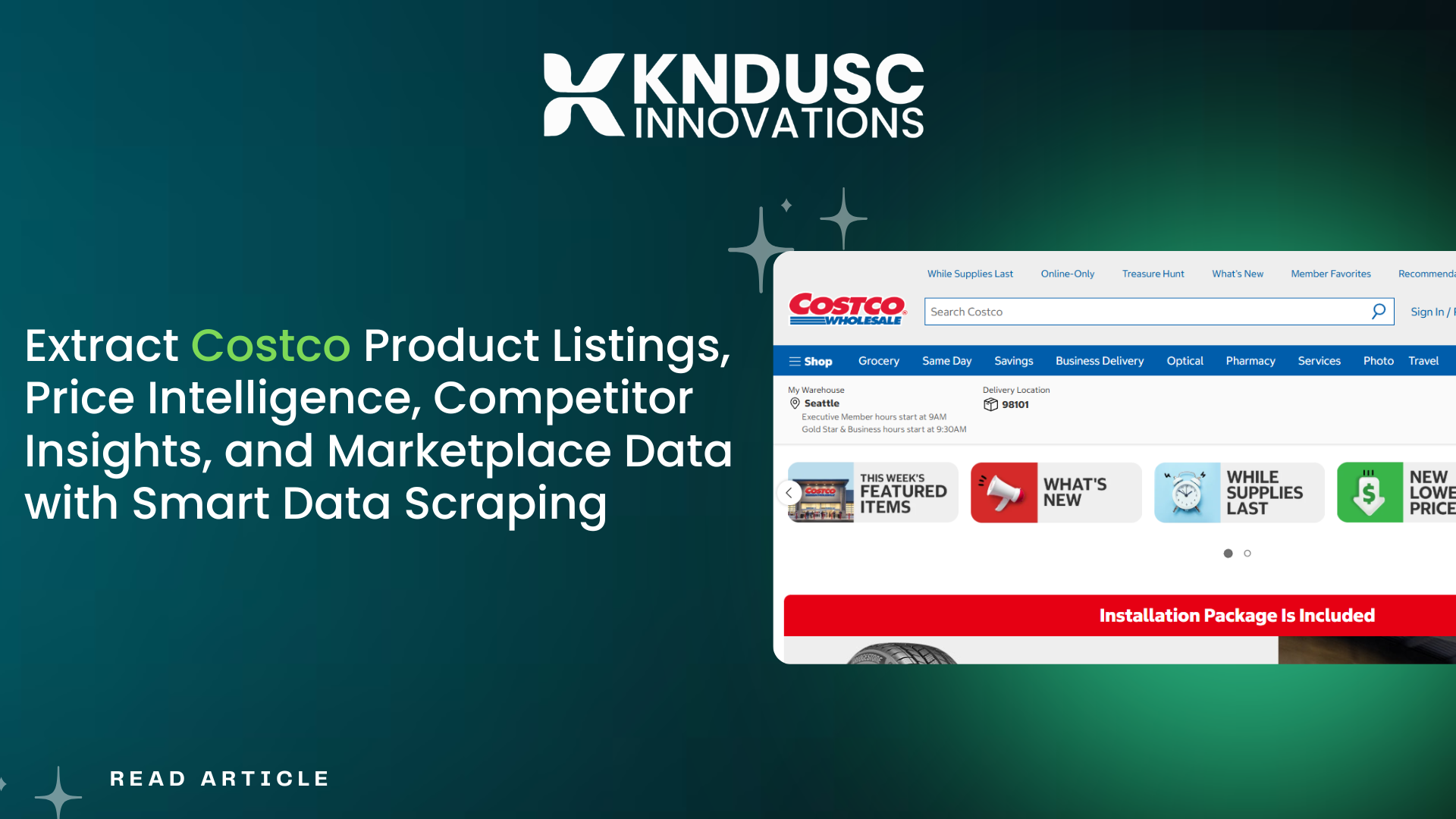
In today’s highly competitive retail environment, data intelligence has become a core driver of strategic growth. Retailers, consumer brands, data analytics firms, and e-commerce intelligence platforms rely on structured marketplace data to monitor pricing strategies, analyze product demand, evaluate competitor positioning, and identify emerging market trends.
Online marketplaces generate enormous volumes of product information every day. Among these platforms, Costco operates as one of the most influential wholesale retail ecosystems, offering thousands of product listings across diverse categories such as electronics, groceries, home goods, fashion, appliances, and health products.
Each product listing contains critical retail signals including product specifications, price changes, discount activity, availability indicators, brand positioning, and customer feedback. While this information is visible on the platform, it is typically designed for browsing rather than large-scale business intelligence or analytical processing.
Without structured extraction frameworks, businesses struggle to convert this marketplace information into usable insights.
This is where web scraping, automated data scraping pipelines, and scalable API architecture play a crucial role.
At KNDUSC, we design enterprise-grade Costco data scraping solutions that transform large volumes of marketplace data into structured datasets optimized for pricing intelligence, product analytics, competitor monitoring, and retail market intelligence platforms.
Through Costco product data scraping, automated web scraping systems, and high-performance data APIs, organizations can transform raw marketplace signals into actionable retail intelligence that supports smarter business decisions.
The Strategic Importance of Costco Marketplace Data
The retail industry has undergone a major digital transformation over the past decade. Today, most product discovery, comparison shopping, and purchasing decisions begin on online marketplaces.
Platforms such as Costco function as centralized hubs for product discovery, price benchmarking, and brand competition.
Within the Costco ecosystem, thousands of brands compete across a wide range of product categories including:
- Electronics and smart devices
- Grocery and packaged food products
- Furniture and home décor
- Clothing and accessories
- Health and wellness products
- Kitchen appliances and cookware
- Office supplies and household essentials
Every listing contains a combination of structured and unstructured retail marketplace data, including:
- Product name and brand identity
- Product category classification
- Product specifications and features
- Pricing signals and discount activity
- Inventory availability indicators
- Customer reviews and ratings
- Promotional campaigns and bundled offers
When collected using Costco web scraping and automated data scraping pipelines, this information becomes a powerful foundation for retail data intelligence and competitor analysis.
Organizations that utilize structured Costco marketplace data gain deeper visibility into pricing patterns, product demand behavior, category growth, and competitive market positioning.
Why Web Scraping Is Essential for Retail Data Intelligence
Retail marketplaces constantly generate dynamic pricing updates, inventory changes, promotional campaigns, and new product listings.
Tracking these signals manually across thousands of SKUs is neither efficient nor scalable.
This is why companies increasingly rely on web scraping and automated data scraping technologies to extract marketplace datasets at scale.
Through Costco data scraping, organizations can systematically collect:
- Product listings across categories
- Product pricing data and discount activity
- Product specifications and attributes
- Inventory availability indicators
- Customer review data
- Brand and category positioning signals
Automated data scraping infrastructure allows companies to continuously capture marketplace intelligence without manual monitoring.
Instead of periodically reviewing competitor products, businesses gain access to real-time retail intelligence powered by scalable web scraping systems.
Types of Data Extracted from Costco Marketplace
Implementing Costco data scraping solutions enables access to several critical layers of marketplace intelligence.
Product Listing Data
Product listings form the foundation of marketplace analytics.
Through Costco product data extraction, organizations can collect:
- Product titles and descriptions
- Brand names and manufacturer information
- SKU identifiers and catalog references
- Category hierarchy and classification
- Product specifications and features
- Product images and media assets
Structured product datasets enable organizations to analyze product assortment strategies and category coverage within the retail ecosystem.
Product Pricing Intelligence
Pricing remains one of the most dynamic variables in online retail marketplaces.
Retailers frequently adjust product prices due to:
- competitor pricing changes
- promotional campaigns
- seasonal demand fluctuations
- supply chain conditions
Through Costco pricing data scraping, organizations can track:
- product price levels across categories
- promotional discounts and bundled offers
- historical price movement patterns
- category price benchmarks
- regional price variations
This structured pricing intelligence allows businesses to develop competitive pricing strategies and dynamic pricing models.
Customer Review Data
Customer reviews provide important signals related to consumer perception and product performance.
Through review data scraping, organizations can extract:
- product ratings
- customer feedback comments
- review volume trends
- sentiment indicators
Analyzing this information enables companies to identify:
- product quality insights
- consumer satisfaction levels
- potential product improvement opportunities
These insights support product innovation and customer experience optimization.
Inventory Availability Signals
Inventory intelligence plays a vital role in supply chain management and retail forecasting.
Through inventory data scraping, organizations can monitor:
- product availability status
- stock-out indicators
- restocking frequency patterns
- category inventory fluctuations
These insights help companies optimize inventory planning, demand forecasting, and supply chain strategies.
Transforming Costco Data into Pricing Intelligence
Collecting marketplace data is only the first step. The real value emerges when this data is transformed into actionable pricing intelligence systems.
Competitive Price Monitoring
Structured Costco pricing data allows organizations to benchmark competitor prices and refine pricing strategies.
Key insights include:
- average category pricing levels
- competitor price positioning
- discount frequency patterns
- promotional campaign tracking
These insights enable companies to maintain competitive price positioning while protecting profit margins.
Product Demand Trend Detection
Consumer demand constantly evolves due to changing preferences, seasonal patterns, and marketing influence.
Analyzing Costco marketplace data allows businesses to identify:
- trending product categories
- rapidly growing brands
- seasonal demand cycles
- emerging product segments
This enables organizations to make data-driven merchandising and procurement decisions.
Product Performance Analytics
Retail businesses evaluate marketplace performance using measurable metrics.
| Metric | Business Insight |
|---|---|
| Average Product Price | Competitive pricing benchmark |
| Discount Rate | Promotion effectiveness |
| Review Sentiment Score | Customer satisfaction level |
| Inventory Availability | Supply chain stability |
| Product Popularity Index | Demand intensity |
These metrics convert raw marketplace signals into actionable retail analytics and strategic insights.
Delivering Marketplace Data Through Scalable APIs
Once marketplace data is extracted and structured, organizations need reliable methods to integrate the data into business intelligence systems.
This is where data APIs become essential.
At KNDUSC, we develop scalable Costco data APIs that enable organizations to access structured marketplace datasets programmatically.
Through retail data APIs, businesses can:
- integrate pricing intelligence into BI dashboards
- automate competitor monitoring platforms
- connect marketplace data with analytics systems
- power machine learning demand forecasting models
API-driven infrastructure enables seamless data integration across enterprise analytics environments.
Building Automated Retail Data Pipelines
Large-scale retail data extraction requires sophisticated engineering infrastructure.
At KNDUSC, we develop automated retail data pipelines that manage the entire lifecycle of marketplace data.
Retail Data Pipeline Framework
1. Web Scraping Infrastructure
Automated systems capture product listings, pricing signals, and review data.
2. Data Cleaning & Standardization
Raw marketplace data is normalized into structured formats.
3. Scalable Data Storage
Structured datasets are stored in secure cloud environments.
4. API Data Delivery
Marketplace intelligence is delivered through high-performance APIs.
5. Analytics Integration
Data integrates seamlessly with dashboards, analytics platforms, and BI tools.
This pipeline converts raw marketplace signals into decision-ready retail intelligence systems.
Key Metrics That Power Retail Marketplace Intelligence
Organizations rely on measurable performance metrics to analyze marketplace activity.
| Metric | Business Value |
|---|---|
| Price Index | Competitive pricing benchmark |
| Discount Frequency | Promotion performance |
| Review Sentiment | Customer satisfaction |
| Product Availability Rate | Inventory stability |
| Category Growth Rate | Demand trend analysis |
These metrics support data-driven retail strategy development.
Challenges in Large-Scale Retail Data Extraction
Although Costco data scraping offers substantial value, extracting marketplace data at scale presents several technical challenges.
Common challenges include:
- dynamic website structures
- anti-scraping protection mechanisms
- frequently updated product listings
- large-scale data processing requirements
- complex product categorization systems
These challenges highlight the need for advanced web scraping infrastructure and professional data engineering expertise.
Why Businesses Choose KNDUSC for Retail Data Intelligence
At KNDUSC, we specialize in building scalable retail data intelligence solutions tailored to modern marketplace environments.
Our services combine:
- advanced web scraping infrastructure
- automated data scraping pipelines
- enterprise-grade data engineering frameworks
- scalable API data delivery systems
Our Capabilities
✔ Costco product data scraping
✔ retail marketplace data extraction
✔ product pricing intelligence
✔ competitor price monitoring
✔ automated data pipelines
✔ scalable retail data APIs
✔ BI dashboard integration
We convert raw marketplace signals into structured data intelligence platforms designed for pricing optimization, competitor analysis, and market research.
Turning Costco Marketplace Data into Strategic Retail Intelligence
The retail industry is rapidly evolving into a data-driven ecosystem where pricing strategies, product selection, and market positioning depend heavily on accurate marketplace intelligence.
Platforms like Costco generate enormous volumes of product listings, pricing signals, inventory indicators, and consumer feedback that reflect real-time retail behavior.
Organizations that leverage Costco web scraping, automated data scraping pipelines, and scalable API infrastructure gain the ability to:
- continuously monitor competitor pricing strategies
- analyze product demand patterns
- track promotional campaigns and discount trends
- optimize inventory planning
- improve retail pricing strategies
By transforming Costco marketplace data into structured intelligence, businesses move beyond reactive decision-making and adopt proactive retail strategies powered by data intelligence.