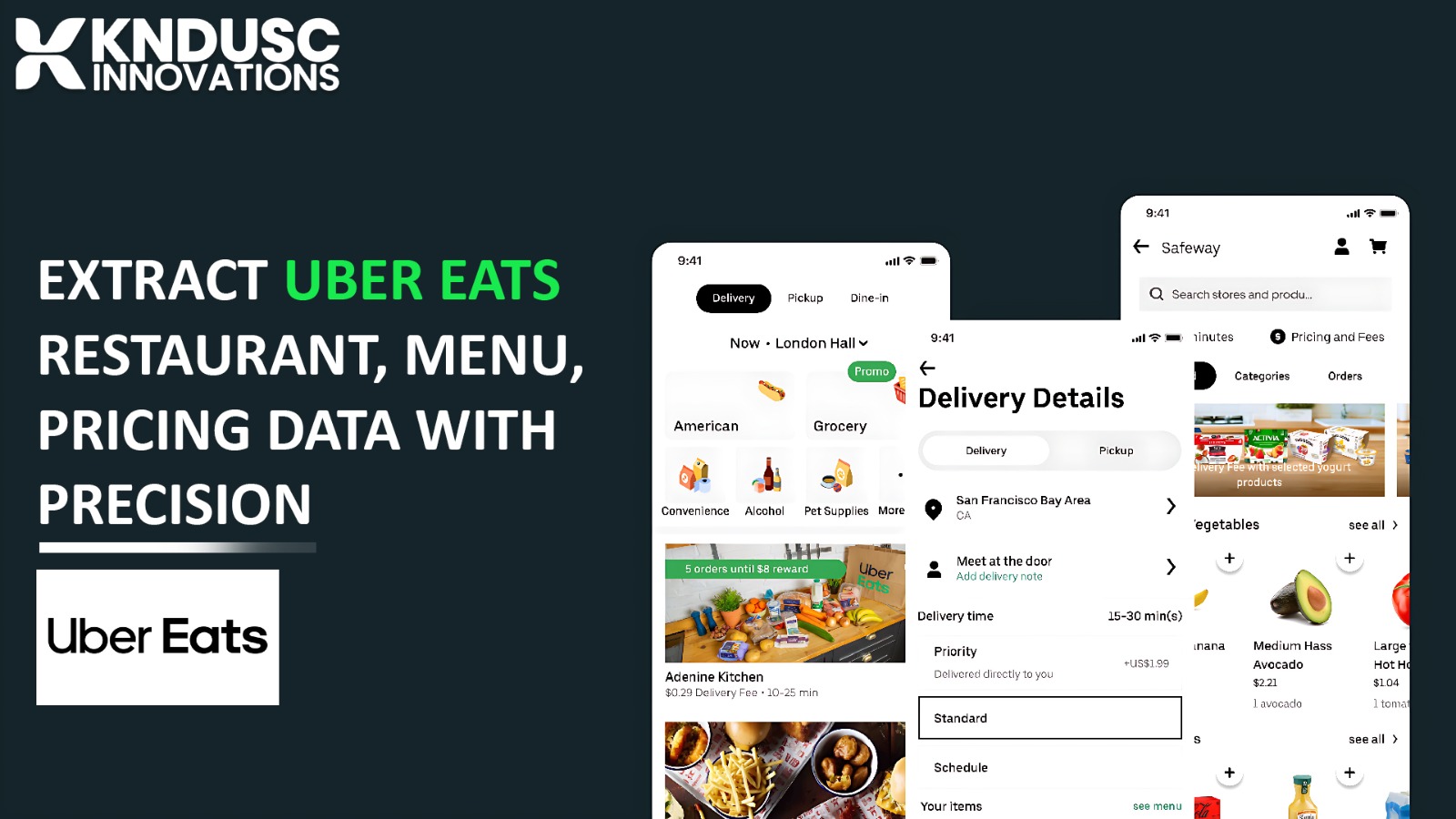
Uber Eats data scraping services enable businesses to collect critical restaurant, menu, and pricing intelligence directly from one of the world's most active food delivery platforms. With reliable and up-to-date Uber Eats data scraping, organizations can analyze menu trends, monitor competitor strategies, track real-time pricing changes, and drive smarter, data-backed business decisions.
Whether you are a restaurant chain, food aggregator, market research firm, or food-tech startup, having access to well-structured Uber Eats data provides a decisive competitive advantage in today's rapidly evolving online food delivery industry.
What is Uber Eats Data Scraping?
Uber Eats data scraping is an automated process of extracting publicly available information from the Uber Eats platform — including restaurant listings, menu items, live pricing, customer ratings, promotional offers, and delivery details. It enables businesses to collect structured, actionable data at scale without any manual effort.
Here is what Uber Eats data scraping typically involves:
Automated Data Collection
Uses intelligent bots and crawlers to continuously extract restaurant and menu data from Uber Eats in real time
Restaurant & Menu Data
Captures restaurant names, cuisine types, menu items, portion details, and live availability status
Ratings & Reviews
Collects customer star ratings, review counts, and feedback summaries to support brand reputation analysis
Pricing Intelligence
Monitors dish prices, platform service fees, surge pricing, seasonal offers, and promotional deals across competitors
Delivery Insights
Extracts estimated delivery times, serviceable zones, packaging costs, and delivery radius boundaries
Structured Output
Delivers clean, organized data in formats including CSV, JSON, or direct API integration
Scalable & Repeatable
Can be configured for hourly, daily, weekly, or real-time data refreshes based on your business needs
Why Uber Eats Data Matters
Uber Eats operates in over 6,000 cities globally and serves tens of millions of active users every month. Extracting structured data from Uber Eats gives businesses unmatched visibility into real-world consumer behavior, pricing dynamics, and live market trends.
Massive User Base
Uber Eats processes millions of daily orders worldwide, making it an unmatched source of real-world demand signals, ordering patterns, and consumer preferences
Real-Time Market Pulse
Menu prices, promotional offers, and item availability update continuously on Uber Eats, giving scraped data a live market intelligence value that reflects current conditions
Competitor Benchmarking
Monitoring rival restaurants on Uber Eats helps businesses identify pricing gaps, high-performing dishes, and promotional strategies worth benchmarking
Consumer Sentiment
Customer ratings and reviews on Uber Eats provide unfiltered insight into what diners love or dislike, enabling brands to continuously refine their offerings
Hyperlocal Insights
Uber Eats operates at a city, neighborhood, and pin-code level, enabling businesses to extract precise, location-specific data for targeted strategies
Revenue Opportunities
Understanding top-performing cuisines, peak ordering windows, and trending dishes empowers businesses to optimize menus and operations for maximum revenue
Types of Uber Eats Data Extracted
Our Uber Eats data scraping services capture a comprehensive range of data points, delivering structured, ready-to-use information tailored to your specific business objectives.
1. Restaurant Information
- Business names, brand identity details, and franchise information
- Complete address, city, area, and precise GPS coordinates
- Contact numbers and customer support details
- Operating hours including peak, off-peak, and late-night timings
- Cuisine categories, food specializations, and dietary focus
- Serviceable zones, delivery coverage areas, and radius boundaries
2. Menu Data
- Dish names and detailed item descriptions
- Portion sizes, serving quantities, and combo configurations
- Calorie counts and nutritional information where available
- Allergen information and key ingredient lists
- Dietary tags including vegan, vegetarian, gluten-free, and halal
- Category classifications such as starters, mains, desserts, beverages, and add-ons
3. Pricing Data
- Current live menu prices across all restaurant listings
- Platform-specific pricing variations and markup differences
- Surge pricing patterns during peak hours and high-demand periods
- Combo, bundle, and meal deal pricing structures
- Seasonal and festive pricing adjustments and limited-time price changes
- Competitor price movements, drops, and historical trend tracking
4. Ratings & Reviews
- Overall restaurant star ratings and aggregate scores
- Individual dish-level reviews and item-specific feedback
- Total review counts and engagement volume metrics
- Verified customer feedback and response indicators
- Restaurant owner reply rates and engagement quality
- Review timestamps and historical sentiment trend analysis
5. Promotional Offers
- Discount percentages, flat-off deals, and introductory offers
- Limited-time flash promotions and countdown deal tracking
- Buy-one-get-one and combo bundle offers
- Platform-specific coupon codes and promo activations
- Festive season, holiday, and event-based campaign data
- Free delivery thresholds, cashback offers, and loyalty reward details
6. Delivery Information
- Estimated delivery time per restaurant and delivery zone
- Minimum order value thresholds and free delivery conditions
- Delivery radius, coverage boundaries, and pin-code mapping
- Packaging charges, handling fees, and service surcharges
- Uber Eats platform commission and service fee structures
- Surge delivery costs during peak hours and high-demand conditions
7. Brand & Seller Data
- Franchise outlet details and multi-location chain profiles
- Parent brand and subsidiary restaurant relationships
- Brand positioning and visibility across Uber Eats categories
- City-wise and region-wise listing presence and search ranking data
- Independent restaurant vs chain brand performance comparison
- New entrant tracking and emerging restaurant brand monitoring
8. Availability & Inventory
- Dish-level stock status and real-time availability flags
- Sold-out indicators, out-of-stock patterns, and restocking signals
- Time-based menu switches such as breakfast, lunch, and dinner menus
- Item-level availability gaps during peak and off-peak hours
- High-demand item tracking and competitor bestseller monitoring
- Seasonal additions, limited-edition items, and rotating menu tracking
Business Use Cases of Uber Eats Data
Uber Eats data, when extracted and transformed into structured datasets, provides powerful insights for restaurants, aggregators, analysts, and food-tech businesses. It enables data-driven strategies across pricing, operations, customer experience, and market expansion.
1. Pricing Optimization & Dynamic Pricing
- Monitor live dish prices and platform fees across competitor listings
- Track discount campaigns, surge pricing windows, and offer cycles
- Adjust your own pricing strategy based on real-time market demand
2. Menu Engineering & Optimization
- Identify top-selling and underperforming menu items on Uber Eats
- Spot trending cuisine categories and high-demand dishes by city
- Redesign menu structures and price points based on competitor data
3. Competitive Intelligence
- Track competitor menus, pricing changes, and new dish launches
- Monitor rival restaurant rankings and visibility on Uber Eats
- Benchmark your brand's performance against top-rated competitors
4. Customer Sentiment & Review Analysis
- Aggregate star ratings and written reviews across all listings
- Identify recurring complaints, service issues, and praise patterns
- Monitor brand reputation shifts over time and by location
5. Demand Forecasting & Trend Analysis
- Track order pattern signals and peak-hour demand windows
- Identify trending cuisines, seasonal spikes, and emerging food categories
- Analyze hyperlocal preferences by city and neighborhood
6. Location Intelligence & Expansion Strategy
- Identify high-demand delivery zones and underserved areas
- Analyze competitor restaurant density in specific locations
- Evaluate new city and market entry opportunities with real data
7. Promotion & Campaign Optimization
- Track competitor discounts, flash deals, and coupon campaigns in real time
- Measure the frequency and aggressiveness of rival promotional activity
- Time your own offers to maximize reach and order conversion
8. Delivery Performance & Logistics Optimization
- Analyze delivery time benchmarks across zones and competitor restaurants
- Monitor fulfillment rate patterns and identify service bottlenecks
- Optimize delivery radius and packaging cost strategies
9. Platform & Listing Optimization
- Improve your restaurant's visibility and search ranking on Uber Eats
- Audit listing quality including images, descriptions, and category tags
- Benchmark top-ranked listings to understand what drives discoverability
10. Revenue & Sales Analytics
- Track revenue trends, average order values, and seasonal demand patterns
- Analyze customer purchase behavior through menu and pricing signals
- Identify growth opportunities across cities and cuisine segments
Challenge
A mid-sized restaurant group operating a chain of 38 dine-in and takeaway outlets across 6 metropolitan cities was experiencing a significant disconnect between their offline success and their Uber Eats performance.
While the brand enjoyed strong walk-in footfall and loyal local customers, their delivery revenue on Uber Eats had plateaued for two consecutive quarters. The leadership team believed competitors were gaining online delivery market share through sharper pricing, more aggressive promotions, and better platform optimization but had no structured data to validate this or take corrective action.
Their specific challenges included:
- No Competitive Pricing Data — The team had zero visibility into how direct competitors were pricing identical or similar dishes across the same Uber Eats delivery zones, making it impossible to position their own pricing competitively
- Blind Spot on Promotions — Competitor restaurants were regularly launching time-sensitive discount campaigns and free delivery deals on Uber Eats that went entirely undetected until their own order volumes dipped noticeably
- Multi-City Menu Inconsistency — With 38 outlets across 6 cities, each listing had slight variations in menu descriptions, item availability, and pricing, but there was no centralized audit process to identify and fix these inconsistencies
- No Dish-Level Trend Intelligence — The marketing team had no data on which specific dishes or cuisine styles were performing best in each city on Uber Eats, leading to generic menu decisions that did not reflect local demand
- Scattered Review Data — Customer feedback across all 38 Uber Eats listings was completely unmonitored in aggregate form, meaning recurring complaints about specific items or service standards in certain cities were never caught early enough to address
- Stalled Expansion Decisions — The group had earmarked 3 new cities for potential expansion but could not confidently assess whether their cuisine category had strong existing demand or would face heavy competition from already-established Uber Eats brands in those markets
The restaurant group needed a comprehensive, automated Uber Eats data scraping solution that could deliver competitor intelligence, own-listing audits, dish-level trend tracking, and hyperlocal market insights all in one centralized, structured data feed.
Solution
KNDUSC Innovations implemented a fully customized Uber Eats data scraping solution designed around the restaurant group's multi-city, multi-outlet requirements. The pipeline was engineered for continuous operation, high data accuracy, and seamless integration with the client's internal reporting tools.
Data Points Extracted:
- Competitor restaurant names, cuisine types, star ratings, and total review volumes
- Full menu catalogs with item names, descriptions, pricing, and category breakdowns
- Platform-specific price variations, surge pricing periods, and discount campaign tracking
- Active promotions, coupon codes, combo offers, and free delivery threshold data
- Estimated delivery times, minimum order values, and delivery zone coverage
- Trending dish flags, bestseller tags, and high-demand item tracking by city
- Customer sentiment scores, review timestamps, and recurring complaint categories
- Own-listing audits across all 38 outlets for pricing errors, availability gaps, and description inconsistencies
Delivery & Integration:
- Structured datasets delivered daily in CSV and JSON formats
- Direct API feed into the client's internal analytics and reporting dashboard
- City-level and outlet-level data segmentation for granular performance tracking
- Automated real-time alerts for significant competitor price changes and new promotional launches
Results Achieved
- Full competitor pricing visibility established across all 6 active cities within 72 hours of go-live
- Promotional campaign detection time reduced from 3 to 4 days down to under 8 hours
- Own-listing audit identified and corrected 190+ pricing inconsistencies and menu errors across 38 outlets
- Manual monitoring effort reduced by over 80%, freeing the marketing team for higher-value strategy work
- Dish-level trend data enabled menu updates in 4 cities within 3 weeks, improving item-level conversion rates
- Delivery order volume on Uber Eats increased by 18% within 75 days of implementing data-driven pricing and menu changes
- Aggregated review monitoring uncovered a recurring complaint pattern in 2 cities, resolved within 30 days
- Expansion into 2 of the 3 target cities confidently greenlit based on competitor density and demand gap analysis
Real-Time Uber Eats Food Delivery Data Intelligence Reference Dataset
| Record ID | Restaurant Name | Cuisine | Location | Menu Item | Price ($) | Discount (%) | Rating | Reviews Count | Delivery Time (mins) | Availability | Order Volume | Platform |
|---|---|---|---|---|---|---|---|---|---|---|---|---|
| UE001 | Burger House | Fast Food | New York, USA | Double Cheeseburger Combo | 13.99 | 15% | 4.6 | 2,450 | 28 | Open | High | Uber Eats |
| UE002 | Taco Fiesta | Mexican | Los Angeles, USA | Beef Tacos (3 pcs) | 11.50 | 10% | 4.4 | 1,320 | 30 | Open | Medium | Uber Eats |
| UE003 | Sushi World | Japanese | San Francisco, USA | Salmon Sushi Roll | 12.99 | 12% | 4.7 | 1,050 | 35 | Open | High | Uber Eats |
| UE004 | Pizza Palace | Italian | Chicago, USA | Pepperoni Pizza | 16.99 | 20% | 4.3 | 1,780 | 40 | Busy | High | Uber Eats |
| UE005 | Curry Delight | Indian | Houston, USA | Butter Chicken | 14.25 | 18% | 4.8 | 2,010 | 38 | Open | High | Uber Eats |
| UE006 | Healthy Greens | Healthy | Seattle, USA | Quinoa Salad Bowl | 12.50 | 10% | 4.5 | 860 | 25 | Open | Medium | Uber Eats |
| UE007 | BBQ Grill House | Barbecue | Dallas, USA | Grilled Chicken Platter | 15.75 | 15% | 4.6 | 940 | 32 | Open | High | Uber Eats |
| UE008 | Noodle Express | Chinese | Boston, USA | Chicken Chow Mein | 11.25 | 12% | 4.4 | 720 | 27 | Open | Medium | Uber Eats |
| UE009 | Falafel Corner | Middle Eastern | Miami, USA | Falafel Wrap | 9.00 | 8% | 4.3 | 580 | 22 | Open | Low | Uber Eats |
| UE010 | Pasta Corner | Italian | Denver, USA | Alfredo Pasta | 14.50 | 17% | 4.5 | 810 | 33 | Open | Medium | Uber Eats |
Why Choose KNDUSC Innovations?
KNDUSC builds Uber Eats data scraping solutions engineered for scale, speed, and reliability. We deliver more than raw data we deliver actionable market intelligence.
Structured Output
Clean datasets in CSV, JSON, or via seamless API integration
Scale Without Interruption
High-volume extraction with robust anti-block and anti-detection infrastructure
Custom Solutions
Fully tailored scraping pipelines built around your specific market and data goals
Ongoing Monitoring
Scheduled daily, weekly, or real-time refreshes with fast delivery and dedicated support
Compliant Practices
Transparent, ethical data collection built entirely on publicly available platform information
End-to-End Partnership
Full support from scoping and development through delivery and dashboard integration
Conclusion
In today's hyper-competitive food delivery landscape, gut instinct and manual observation are no longer enough to stay ahead. Uber Eats has evolved into far more than a food ordering app it is a living, real-time marketplace where pricing shifts by the hour, promotional campaigns launch without warning, and consumer preferences change faster than any team can manually track.
Businesses that treat Uber Eats as just a delivery channel are leaving significant intelligence on the table. Every listing, every price point, every customer review, and every promotional offer published on the platform is a data signal and when those signals are captured, structured, and analyzed at scale, they become a powerful strategic asset.
Uber Eats data scraping bridges the gap between raw platform activity and actionable business intelligence. It gives restaurant chains the visibility to price competitively, food aggregators the insight to optimize partner performance, market researchers the depth to understand hyperlocal demand, and food-tech startups the foundation to build data-driven products.
Whether your goal is to reduce pricing blind spots, respond faster to competitor promotions, improve your Uber Eats listing quality, identify expansion-ready markets, or simply understand what your customers truly want structured Uber Eats data is the engine that powers every one of those decisions.
At KNDUSC Innovations, we do not just deliver data. We deliver clarity, speed, and competitive advantage one structured dataset at a time.
The businesses winning on Uber Eats today are not the ones with the biggest budgets. They are the ones with the best data.
Turn listings into leverage. Turn data into decisions.
Frequently Asked Questions (FAQ)
Q1. What is Uber Eats data scraping and how does it work?
Uber Eats data scraping is an automated process of extracting publicly available information from the Uber Eats platform using bots and crawlers. The system visits restaurant listings, menu pages, and promotional sections on Uber Eats, collects structured data points such as prices, ratings, delivery times, and offers, and delivers them in clean, organized formats like CSV, JSON, or via API. The entire process runs automatically without any manual browsing or data entry.
Q2. What types of data can be extracted from Uber Eats?
Our Uber Eats scraping solutions can extract a wide range of data including restaurant names, addresses, GPS coordinates, cuisine types, operating hours, full menu catalogs with item names and descriptions, live pricing, combo and bundle offers, customer star ratings and reviews, active discount campaigns, estimated delivery times, minimum order values, delivery zone coverage, sold-out item indicators, and platform service fee structures. The data can be filtered by city, cuisine category, price range, or any other parameter relevant to your needs.
Q3. Is scraping data from Uber Eats legal?
Uber Eats data scraping involves the collection of publicly available information that any user can view without logging in or bypassing any security measures. Extracting this type of publicly accessible data for research, competitive analysis, and business intelligence purposes is a widely practiced and accepted industry approach. KNDUSC follows transparent, ethical, and compliant data collection practices. However, we always recommend that clients consult their own legal advisors regarding specific use cases and regional data regulations applicable to their business.
Q4. How frequently can Uber Eats data be updated?
We offer flexible data refresh schedules based on your business requirements. Options include real-time continuous scraping, hourly updates, daily refreshes, weekly snapshots, or custom schedules designed around your operational needs. For businesses tracking fast-moving data like surge pricing, flash deals, or sold-out item patterns, we recommend real-time or hourly refresh cycles. For competitive benchmarking and trend analysis, daily or weekly updates are typically sufficient.
Q5. In which cities and countries is Uber Eats data available?
Uber Eats operates in over 6,000 cities across 45+ countries globally. Our scraping solutions can extract data from any geography where Uber Eats is actively operating, including major markets across North America, Europe, Asia Pacific, the Middle East, Latin America, and Africa. We support city-level, region-level, and country-level data extraction, and can target specific neighborhoods or pin codes for hyperlocal intelligence.
Q6. How is the extracted Uber Eats data delivered?
Extracted data is delivered in structured, ready-to-use formats based on your preference. Standard delivery options include CSV files, JSON files, and direct API integration into your existing dashboard or analytics platform. We can also deliver data via cloud storage solutions, scheduled email reports, or direct database feeds depending on your technical infrastructure and workflow requirements.
Q7. Can you scrape Uber Eats data for specific restaurants or cuisine categories only?
Yes. Our Uber Eats scraping solutions are fully customizable. You can specify exact restaurants, cuisine types, price brackets, delivery zones, city areas, or any combination of filters to ensure the data collected is precisely aligned with your competitive landscape and market focus. Custom filtering helps keep datasets lean, relevant, and cost-efficient.
Q8. Can Uber Eats data scraping help with my own restaurant listing optimization?
Absolutely. Beyond competitor monitoring, our solution can audit your own Uber Eats listings across all outlets to identify pricing inconsistencies, availability errors, outdated menu descriptions, missing item images, and category misplacements. By comparing your listings against top-ranked competitors in the same category, we can highlight specific gaps in presentation, pricing, and offer structure that may be affecting your search visibility and order conversion rate on the platform.