The rapid growth of food delivery platforms has transformed the restaurant industry into a data-rich ecosystem. Every menu item, price change, customer rating, and review shared on these platforms represents valuable intelligence. Businesses that can tap into this data gain a powerful advantage in understanding market trends, optimizing pricing, and enhancing customer experience.
This is where food delivery data scraping plays a crucial role.
In this comprehensive guide, we’ll explore how to extract menu prices and ratings from food delivery apps, the tools and techniques involved, real-world use cases, and how companies like kndusc help businesses unlock actionable insights at scale.
What is Food Delivery Data Scraping?
Food delivery data scraping is the automated process of collecting publicly available data from food delivery platforms such as Uber Eats, DoorDash, GrabFood, and Deliveroo.
This process allows businesses to extract food delivery app data for business intelligence, including:
- Restaurant names and locations
- Menu items and categories
- Prices and discounts
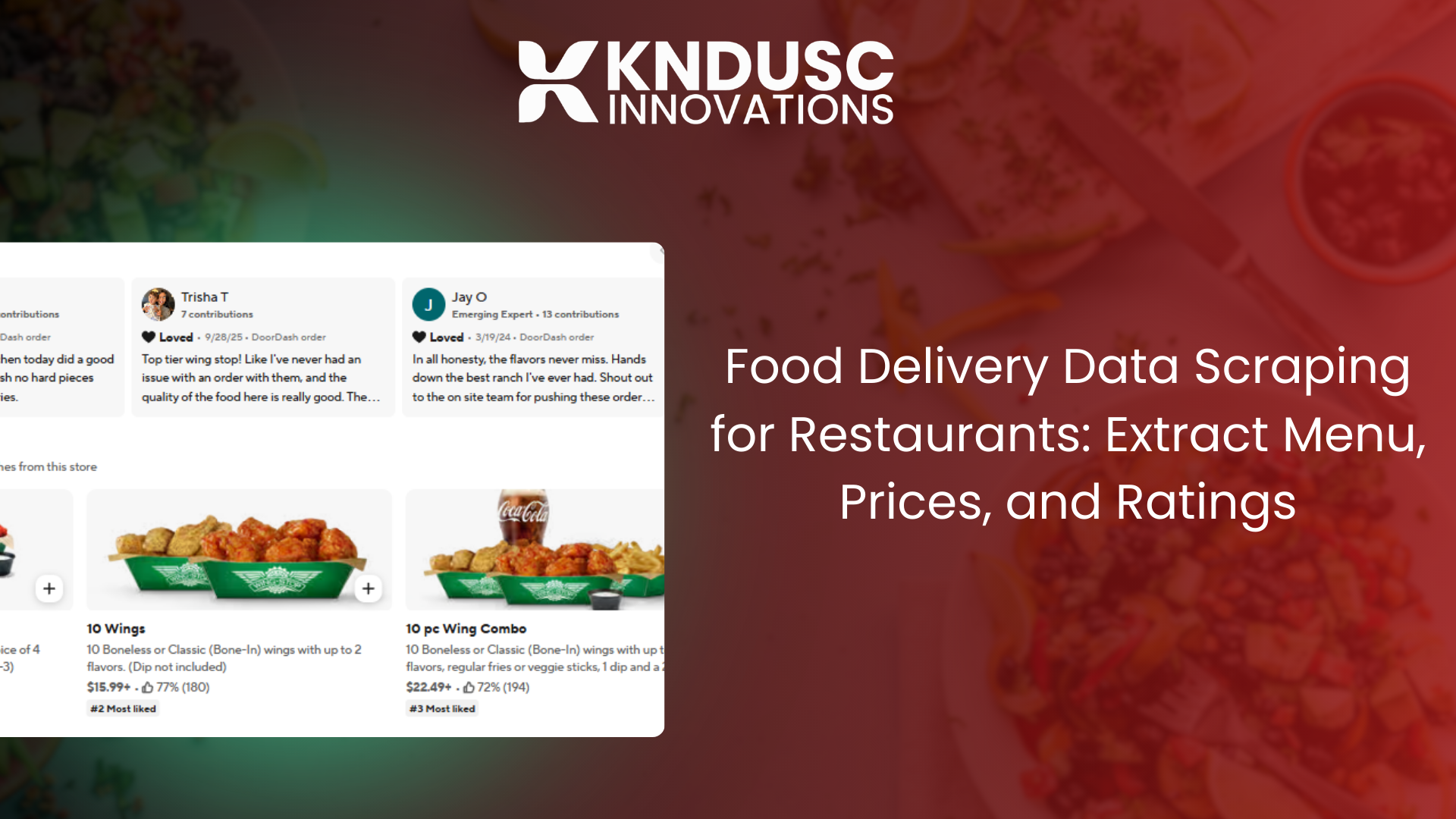
- Customer ratings and reviews
- Delivery times and service fees
By using advanced tools, companies can scrape restaurant menu data from food delivery apps and convert raw data into structured, actionable insights.
Why Food Delivery Data Scraping Matters
In today’s competitive food industry, data is no longer optional, it’s essential. Businesses rely on food delivery data scraping for market research to stay ahead.
1. Competitive Pricing Intelligence
Pricing can make or break a restaurant’s success. By leveraging restaurant data extraction for pricing intelligence, businesses can:
- Monitor competitor pricing in real time
- Identify underpriced or overpriced items
- Adjust pricing dynamically
This is especially useful when you extract menu prices and ratings for competitor analysis.
2. Menu Optimization
Analyzing scraped data helps businesses understand:
- Which dishes are trending
- Which items perform best
- How competitors structure their menus
This enables smarter decisions when designing menus and promotions.
3. Customer Insights
Customer reviews and ratings are a goldmine of feedback. Businesses can:
- Scrape restaurant ratings and reviews from delivery apps
- Identify recurring complaints
- Improve food quality and service
4. Market Expansion
Using food delivery scraping for real-time pricing insights, businesses can identify:
- High-demand areas
- Untapped markets
- Popular cuisines in specific regions
Key Data You Can Extract
When you extract food delivery platform data, you gain access to several valuable datasets:
Menu Data
- Item names
- Descriptions
- Categories
Pricing Data
- Base prices
- Discounts
- Combo offers
Ratings & Reviews
- Average ratings
- Number of reviews
- Customer sentiment
Operational Data
- Delivery times
- Availability
- Fees
This data is essential for automated restaurant data scraping for competitive analysis.
How to Scrape Restaurant Menu Data from Food Delivery Apps
If you're wondering how to scrape restaurant menu data from food delivery apps, here’s a step-by-step approach:
Step 1: Identify Target Platforms
Focus on popular platforms such as:
For example, McDonald's data scraping in USA is highly valuable for businesses targeting Southeast Asia.
Step 2: Choose the Right Tools
To extract JSON data from food delivery APIs or scrape web pages, you can use:
- Python libraries like BeautifulSoup and Scrapy
- Selenium for dynamic websites
- API-based solutions
These tools are commonly used for web scraping restaurant menus using BeautifulSoup.
Step 3: Handle Dynamic Websites
Many food delivery platforms rely on JavaScript. To scrape dynamic food delivery websites with Selenium, you need:
- Browser automation
- Headless browsers
- Advanced scraping frameworks
Step 4: Avoid Getting Blocked
To ensure the best way to scrape food delivery data without getting blocked, implement:
- Proxy rotation
- User-agent rotation
- Request throttling
Step 5: Store and Analyze Data
Once collected, data should be:
- Cleaned and structured
- Stored in databases
- Visualized using analytics tools
This enables tools to extract food delivery app data at scale.
API vs Web Scraping for Restaurant Data Extraction
A key consideration is API vs web scraping for restaurant data extraction.
API-Based Extraction
Advantages:
- Structured data
- Faster access
- Reliable
Disadvantages:
- Limited access
- Requires authorization
Web Scraping
Advantages:
- Access to publicly available data
- Greater flexibility
Disadvantages:
- Requires maintenance
- Risk of blocking
Most businesses combine both methods to extract food delivery platform data efficiently.
Real-World Applications
1. Competitor Analysis
Businesses use scraping Grubhub menu and prices data to:
- Track competitor pricing
- Analyze menu strategies
- Benchmark performance
2. Dynamic Pricing
With food delivery scraping for real-time pricing insights, companies can:
- Adjust prices based on demand
- Offer targeted promotions
3. Customer Sentiment Analysis
By analyzing reviews, businesses can:
- Improve service quality
- Identify customer pain points
4. Aggregator Platforms
Startups use tools to extract food delivery app data at scale to build:
- Comparison platforms
- Recommendation engines
Platform-Specific Data Scraping
When it comes to food delivery data scraping, targeting specific platforms allows businesses to extract menu data, prices, and customer ratings efficiently. Each platform provides unique insights into restaurant performance, pricing strategies, and customer preferences.
| Platform | Key Data You Can Extract | Best For |
|---|---|---|
| Uber Eats | Menu items, prices, ratings, reviews | Global competitor analysis |
| DoorDash | Restaurant listings, delivery fees, reviews | US market insights |
| GrabFood | Menu prices, ratings, location data | Southeast Asia market research |
| Deliveroo | Menu data, delivery time, ratings | Europe & Asia insights |
| EatStreet | Menu pricing, offers, restaurant data | Regional US analysis |
| Grubhub | Ratings, reviews, menu data | Customer sentiment analysis |
| Glovo | Menu, pricing, multi-category data | Multi-service insights |
| McDonald’s | Menu prices, promotions, combos | Brand benchmarking |
Platform Highlights
- Uber Eats – Ideal for extracting menu items, prices, ratings, and reviews globally to analyze competitor performance.
- DoorDash – Useful for scraping restaurant listings, delivery fees, and customer reviews across the US market.
- GrabFood – Perfect for extracting menu prices and ratings in Singapore and Southeast Asia for market research.
- Deliveroo – Helps capture menu data, delivery times, and ratings to analyze restaurant performance in Europe and Asia.
- EatStreet – Enables scraping menu pricing, offers, and restaurant data in regional US markets for pricing intelligence.
- Grubhub – Ideal for collecting restaurant ratings, reviews, and menu data to assess customer sentiment.
- Glovo – Useful for extracting multi-category delivery data, including menu and pricing insights across regions.
- McDonald’s – Valuable for benchmarking menu prices, promotions, and combos against global fast-food standards.
Challenges in Food Delivery Data Scraping
Despite its benefits, scraping comes with challenges:
1. Anti-Bot Protection
Websites actively prevent scraping.
2. Frequent Updates
UI changes can break scrapers.
3. Legal Compliance
Ensure adherence to:
- Terms of service
- Data protection laws
4. Data Quality Issues
Raw data must be cleaned and structured.
How kndusc Supports Data Scraping?
kndusc provides advanced food delivery data scraping services for restaurants, helping businesses extract high-quality data efficiently.
Key Features:
- Real-time data extraction
- Scalable scraping solutions
- Clean, structured datasets
- Custom data pipelines
By partnering with kndusc, companies can outsource food delivery data scraping services and focus on growth strategies.
Benefits of Outsourcing Data Scraping
Many companies prefer to outsource food delivery data scraping services instead of building in-house systems.
Benefits:
- Reduced development time
- Access to expert solutions
- Scalability
- Cost efficiency
This approach is ideal for automated restaurant data scraping for competitive analysis.
Best Practices for Effective Scraping
To maximize results:
Focus on Data Accuracy
Ensure clean and reliable datasets.
Use Scalable Systems
Handle large volumes of data efficiently.
Monitor Changes
Update scrapers regularly.
Stay Ethical
Follow legal and ethical guidelines.
Future Trends in Food Delivery Data Scraping
The future of food delivery platform data extraction services includes:
- AI-powered analytics
- Real-time data pipelines
- Integration with BI tools
- Hyperlocal insights
Businesses investing in extracting restaurant menu prices and ratings from food delivery apps will gain a competitive edge.
Food delivery platforms are a treasure trove of data waiting to be unlocked. By leveraging food delivery data scraping, businesses can gain deep insights into menus, pricing, and customer preferences.
From scraping restaurant ratings and reviews from delivery apps to enabling smarter pricing strategies, the benefits are immense.
Whether you're conducting food delivery data scraping for market research or building a competitive strategy, the ability to extract menu prices and ratings for competitor analysis is a powerful advantage.
With expert solutions from kndusc, businesses can efficiently extract food delivery app data for business intelligence and stay ahead in a rapidly evolving market.
FAQ – Food Delivery Data Scraping
Q1: What is food delivery data scraping?
A: Food delivery data scraping is the process of automatically extracting structured information like menus, prices, ratings, and customer reviews from food delivery apps and platforms for analysis or business intelligence.
Q2: Why should restaurants use food delivery data scraping?
A: Restaurants use data scraping to analyze competitor menus, monitor pricing trends, track customer ratings, and optimize their offerings based on real-time insights from food delivery platforms.
Q3: Which platforms can I scrape data from?
A: You can scrape menu data, prices, and ratings from platforms like Uber Eats, DoorDash, GrabFood, Deliveroo, EatStreet, Grubhub, Glovo, and even brand-specific apps like McDonald’s.
Q4: What types of data can I extract from food delivery apps?
A: Typical data includes menu items, item descriptions, prices, discounts, customer ratings, reviews, delivery times, and operational details.
Q5: Is food delivery data scraping legal?
A: While scraping publicly available data is generally legal, businesses must comply with platform terms of service and data protection laws. Using professional services like kndusc ensures safe and compliant scraping practices.
Q6: What tools can I use for food delivery data scraping?
A: Popular tools include Python libraries (BeautifulSoup, Scrapy), Selenium for dynamic websites, and API-based solutions when available. These help extract structured menu, price, and ratings data efficiently.
Q7: Can I use scraped data for pricing analysis?
A: Yes, scraped menu prices and ratings allow restaurants and food-tech companies to perform competitive pricing analysis, optimize menus, and develop data-driven promotional strategies.
Q8: How does kndusc help with food delivery data scraping?
A: kndusc provides scalable, real-time, and structured data scraping services, enabling businesses to extract menu prices, ratings, and other insights without worrying about technical or compliance challenges.