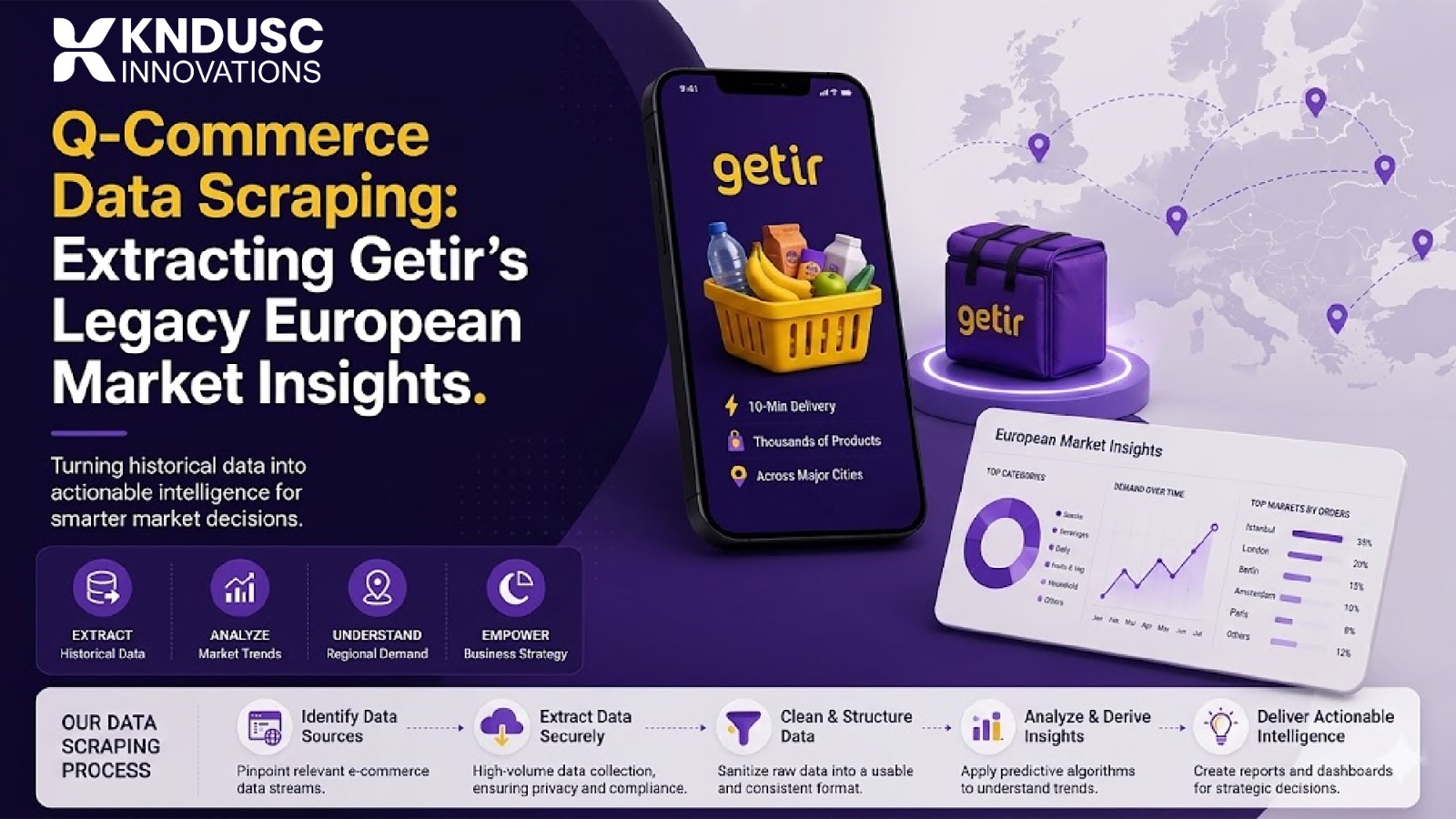
The landscape of ultra-fast grocery delivery (Q-commerce) underwent a massive structural shift when Getir executed its historic operational pivot, consolidating its footprint away from the UK, Germany, the Netherlands, and France to focus exclusively on its core domestic markets. This sudden consolidation left behind a multi-billion-dollar market vacuum across Western Europe. Traditional supermarkets, dark-store competitors, and third-party delivery apps are now aggressively competing to capture displaced consumer demand.
To successfully win this reassigned retail market share, global enterprise brands cannot rely on speculation. Winning requires cold, hard data.
- Where exactly were the highest-density fulfillment dead zones left behind?
- How have legacy pricing benchmarks across regional European metros fluctuated since the market consolidation?
- Which specific hyper-local product categories are driving current demand on substitute delivery applications?
By utilizing specialized Getir data scraping strategies to parse historical application caches, archive metrics, and live substitute delivery channels, enterprise retail brands can build a precise map of localized consumer trends. In this piece, we dig into the technical frameworks required to extract, normalize, and weaponize quick-commerce datasets across Western Europe's most competitive delivery landscapes.
1. Navigating the Post-Exit Data Landscape: Why Legacies Still Matter
When a dominant digital player exits a region, their historical data footprint does not lose value; it becomes a roadmap for surviving competitors. Scraping and assessing quick-commerce application structures across Germany, the UK, France, and the Netherlands provides deep context for cross-border logistics.
1. Germany (The Berlin & Rhine-Ruhr Hubs)
Germany's dense urban centers were the primary battleground for quick-commerce apps. By extracting localized historical SKU availabilities and regional pricing data, retail brands can discover exactly which consumer segments in major German metros are most receptive to automated premium delivery models.
2. United Kingdom (The London-Centric Delivery Grid)
The UK market featured incredibly high order volumes coupled with steep customer-acquisition subsidies. Scraping historical localized product ranges and matching them against active supermarket delivery networks allows logistics teams to map out modern delivery demand without wasting capital on speculative marketing campaigns.
3. The Netherlands (Hyper-Dense Urban Clusters)
Dutch cities present unique logistics challenges due to localized zoning laws regarding dark store distribution warehouses. Scraping past point-of-interest data grids helps emerging e-commerce platforms identify precisely where dark stores can operate efficiently under strict local guidelines.
4. France (The Parisian Retail Core)
France’s strict regulatory landscape heavily managed flash-delivery networks. Analyzing historical application data allows compliance officers and expansion planners to see exactly what product catalog mixes successfully operated within tight local legal structures.
2. Core Quick-Commerce Data Layers to Target for Extraction
To construct a high-fidelity competitive model, your web scraping infrastructure must isolate and extract specific data structures:
| Targeted Data Layer | Specific Technical Components | Strategic Analytics Value |
|---|---|---|
| Catalog Metadata | Brand Name, Product Categorization, Sub-Category Hierarchies, Unit Volumes | Standardizes product cross-referencing across different competing digital shelves. |
| Historical Pricing | Base Product Cost, Promotion/Discount Multipliers, In-App Delivery Fees | Establishes baseline pricing thresholds required to capture displaced users. |
| Fulfillment Footprints | Dark Store Coordinates, Regional Delivery Radius Boundaries, Out-Of-Stock Indicators | Identifies exact geographical areas with unfulfilled delivery demands. |
| Consumer Sentiments | Popular In-App Bundles, Frequently Bought Together Arrays, Peak Order Windows | Informs hyper-local product placement and flash promotion schedules. |
3. The Technical Hurdles of Crawling Modern Q-Commerce Architectures
Many internal data-science divisions fail when trying to scrape on-demand delivery apps because they treat them like traditional static websites. Quick-commerce platforms operate on entirely different architectural principles.
Mobile-First API Shielding
Quick-commerce networks operate primarily via native iOS and Android applications rather than open web pages. The underlying data is delivered through highly secure, private backend APIs shielded by advanced token authentication layers and cryptographic signatures. Extracting this data requires advanced reverse-engineering of the app's endpoint routing and mobile user-agent simulations.
Dynamic Geo-Fencing Constraints
On-demand delivery apps do not show a uniform catalog. Content is completely dynamic, changing depending on the precise latitude and longitude coordinates provided by the user's mobile device. To scrape a comprehensive city-wide map, an automated data collection pipeline must continuously cycle through precise geo-coordinate parameters to trick the app's servers into revealing localized product arrays.
4. Deploying a Resilient Q-Commerce Data Harvesting Pipeline
Overcoming these modern anti-bot frameworks requires an advanced, adaptive data collection strategy:
[Target: Mobile App API Endpoints]
                ▲
                │  (Geo-Coordinate Spoofing + Rotating European Mobile Proxies)
[KNDUSC Automated Scraping Infrastructure]
                │
                ▼  (Multi-Byte Text Sanitization & Schema Normalization)
[Clean Enterprise Business Intelligence Feed]
- Geo-Coordinate Spoofing Networks: To extract accurate regional pricing across Germany or the UK, web crawlers must feed localized GPS parameters into API request headers, simulating authentic regional requests.
- Mobile-Carrier Proxy Meshes: Standard cloud hosting data center IPs face immediate blocks from application firewalls. Resilient web scraping relies on specialized mobile-carrier proxy networks (4G/5G) to make automated data queries look exactly like standard smartphone users browsing over cellular networks.
5. Converting Chaotic App Code into Structured Market Assets
Raw JSON responses pulled from mobile app endpoints are messy, full of internal tracking IDs, localized currency symbols, and fragmented language formats.
Automated Language and Currency Normalization
When dealing with cross-border European data, an advanced data pipeline must instantly parse mixed language sets—such as converting German or French product descriptions into standardized internal taxonomies while mapping Euro (EUR) and British Pound (GBP) values into single relational columns.
Cross-Platform Shelf Mapping
Because multiple delivery networks name the exact same grocery products differently, data pipelines use advanced machine learning string-matching to link different internal SKU records back to a single master product index. This allows business intelligence platforms to compare prices across different applications flawlessly.
6. Enterprise Applications: Who Profits from This Intelligence?
- Fast-Moving Consumer Goods (FMCG) Brands: Identify product gaps left behind by exiting networks to quickly pitch substitute product lines to surviving delivery platforms.
- Surviving Q-Commerce Platforms: Scrape historical competitor pricing models and coverage zones to capture displaced users efficiently without triggering a margin-destroying price war.
- Commercial Real Estate Investors: Analyze the historical layout of quick-commerce dark stores to repurpose urban logistics spaces for modern hyper-local operations.
7. Fully Managed Data Infrastructure: Let KNDUSC Do the Heavy Lifting
Building, maintaining, and adapting internal data scrapers to handle complex mobile application architectures is an expensive, continuous drain on corporate engineering teams. When mobile API schemas or authentication headers change unexpectedly, internal scripts break immediately, causing critical data blackouts.
KNDUSC Innovations eliminates this massive technical overhead through our fully managed Data-as-a-Service (DaaS) model:
- Custom Scoping and Design: We carefully outline your needed target metrics, regional focus parameters, and internal data structures.
- Risk-Free Custom Datasets: Our team builds an initial pipeline prototype and generates a clean sample dataset tailored to your exact database specifications, entirely free of charge.
- Automated Enterprise Scale: Once verified, data streams scale seamlessly to production volumes. Pristine data is delivered straight into your internal analytics stacks via custom low-latency APIs, secure cloud storage buckets (AWS S3, Google Cloud Storage), or secure SFTP integrations.
8. Conclusion: Seize the Modern Retail Edge
In the fast-paced, highly fluid European retail market, relying on lagging statistics or slow manual reviews puts your organization at a massive disadvantage. Deploying automated web data extraction gives your company a clear, real-time look at moving consumer demands, localized competitor pricing shifts, and evolving market trends.
Stop fighting with broken scripts, mobile API blocks, and messy raw code. Partner with the data engineering experts at KNDUSC Innovations to build a dependable, fully automated data pipeline configured precisely for your company's strategic goals.
Ready to harness deep marketplace data? Contact KNDUSC Innovations today. Our senior data architects will assess your project scope and deliver a comprehensive data blueprint within one business hour.