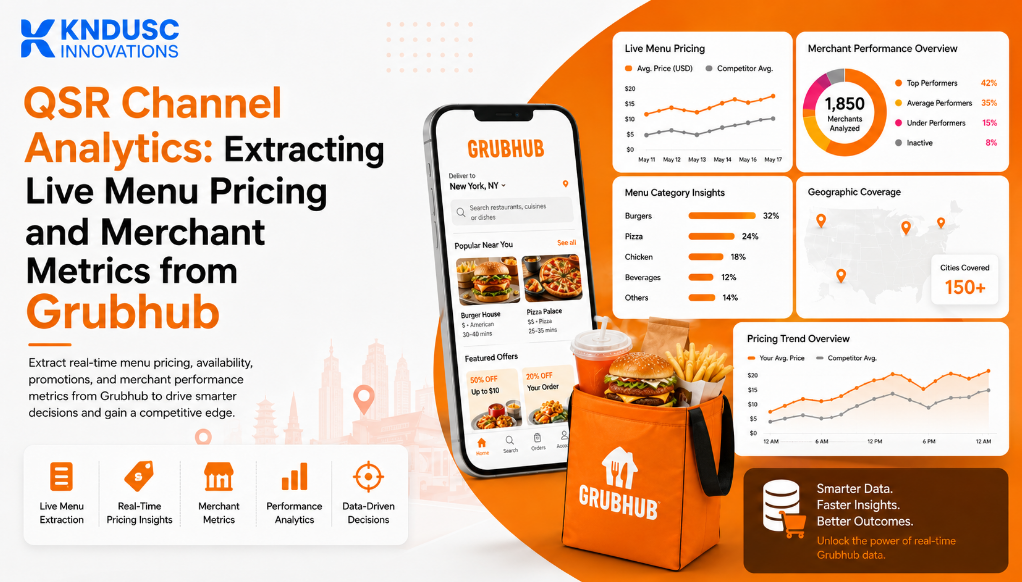
The operational landscape for quick-service restaurants (QSRs), ghost kitchens, and hospitality consumer groups requires real-time channel visibility. Because menus, item configurations, and fulfillment parameters are calculated on the fly based on local demand and merchant availability, relying on national averages or static reports will skew competitive models. To defend digital shelf positioning in North America, corporate analytics groups monitor the live storefront of on-demand food commerce: Grubhub.
As a primary pillars of US food delivery, Grubhub handles massive daily transaction volumes across an interconnected grid of national chains, localized franchises, and independent culinary operations. For an enterprise, the strategic goal is to extract these hyper-local market signals at scale—allowing commercial teams to track competitor pricing variations, verify brand positioning, and optimize localized commission adjustments before consumer preferences shift.
Deploying a dedicated, high-capacity data harvesting infrastructure removes the technical friction of manual menu monitoring. Corporate strategy groups leverage specialized data scraping and data extraction services to gather structured datasets from complex application layouts safely. This breakdown maps out the distinct data configurations unique to multi-tenant food delivery networks and details how to manage the technical limits of collecting Grubhub data cleanly.
Isolating the Key Operational Layers of Food Aggregator Networks
Unlike standard retail catalogs where products map cleanly to standalone serial codes, food aggregator menus are highly nested, conditional data blocks. A resilient data collection pipeline must separate and target three specific operational variables.
1. Nested Menu Option and Surcharge Arrays
A single restaurant item often contains multiple layers of customizations—such as choosing proteins, adding sides, or selecting sizes. On Grubhub, these choices carry independent, nested price variations that do not print on the primary landing page container. If an extraction script only captures the base item label, it misses the true transaction cost to the consumer. High-fidelity data collectors must parse the underlying client-side JSON states to extract the entire customization matrix cleanly.
2. Hyper-Local Delivery Surcharges and Geo-Fenced Promos
Grubhub alters storefront visibility, calculated delivery fees, and active restaurant promotions dynamically based on the exact drop-off coordinates provided by the user. A data script running from a basic cloud server will pull inaccurate default values or hit closed storefront walls. To draw true market reality, an automated collection engine must pass precise local latitude and longitude tokens directly into session configuration variables to uncover store-specific operating menus.
3. Cross-Platform Markup Matrices
Restaurant brands routinely adjust their baseline menu pricing upward across third-party marketplaces to balance platform commission percentages and service fees. To run an accurate strategic audit, business intelligence platforms must track these markups side-by-side with independent point-of-sale data, verifying how different aggregators manage local customer checkout totals.
Overcoming Application Security Walls Without Data Blackouts
Grubhub utilizes highly strict network security perimeters to protect its proprietary restaurant networks, partner details, and live delivery rates from automated scrapers. Standard, lightweight scripts that attempt to copy text from web page templates will face immediate connection failures.
The core challenge for development teams is advanced browser fingerprint screening at the network edge. The platform's firewalls analyze the incoming technical profile well beyond basic IP rate-limiting. They review connection parameters for mismatched encryption handshakes, incomplete client metadata, or mechanical request tempos that lack human browsing traits like variable reading delays or non-linear page scrolling. When flagged, the server drops the connection, returning severe HTTP 403 blocks or complex verification walls.
Furthermore, because Grubhub operates primarily as a mobile-first framework, the frontend website serves as a shell, loading its actual content asynchronously via private, token-authorized JSON APIs. Bypassing these barriers requires utilizing fully rendered headless browsers configured to accurately mirror genuine consumer navigation patterns. To ensure data continuity and pull accurate local pricing, request traffic must be distributed across high-quality regional residential and mobile carrier proxy nodes, making queries look identical to real local customers ordering dinner from their smartphones.
Cross-Examining Delivery Data Across Global Regions
To establish a definitive competitive edge across the food and logistics sectors, business analytics groups must evaluate local marketplace metrics alongside parallel delivery networks. Our scalable data streams allow your internal business tools to review these insights side-by-side with your existing market maps using direct, clean canonical links.
For instance, your data models can cross-reference direct US consumer channels using our dedicated DoorDash data scraping services, check alternative food delivery platforms via our specialized food delivery data scraping guide, evaluate high-volume restaurant data through our custom McDonald's menu data extraction post, or monitor parallel European hyper-local networks using our integrated Deliveroo scraper API pipeline.
Fully Managed Restaurant Data Pipelines: Eliminate Technical Overhead
Continually rewriting code to handle changing mobile app APIs, updated token handshakes, and proxy network rotations is an expensive, ongoing distraction for internal software developers. On-demand delivery applications update their backend systems frequently. The moment a platform alters its verification headers or scrambles its internal code, home-grown scripts break down, leaving your strategic analytics platforms with critical data gaps.
At KNDUSC Innovations, we eliminate this engineering burden completely by delivering a premium, end-to-end Data-as-a-Service (DaaS) model.
Our team aligns directly with your data science division to map out your exact needed variables, target urban delivery coordinates, and preferred delivery destinations. We then construct a custom processing pipeline and deliver a tailored, high-fidelity sample dataset configured perfectly to your internal database parameters, completely free of charge.
Once verified, data harvesting scales seamlessly to match your enterprise volumes. Pristine, structured information is piped straight into your business workflows via custom api integrations, secure cloud storage options, or direct webhook connections.
Summary: Capture Your Quick-Commerce Advantage
In hyper-competitive on-demand delivery networks, relying on lagging statistics or slow manual audits leaves your brand at a permanent operational disadvantage. Implementing automated web data extraction provides a real-time window into competitor menu adjustments, localized delivery fees, and shifting regional consumption habits.
Stop fighting with proxy errors, browser fingerprint bans, and broken scraping scripts. Partner with the data engineering specialists at KNDUSC Innovations to build a dependable, fully automated data pipeline configured precisely for your company's strategic goals.
Ready to harness deep quick-commerce market intelligence? Contact our strategy team today through our main solutions portal. Our senior data architects will assess your project scope and deliver a comprehensive data blueprint within one business hour.