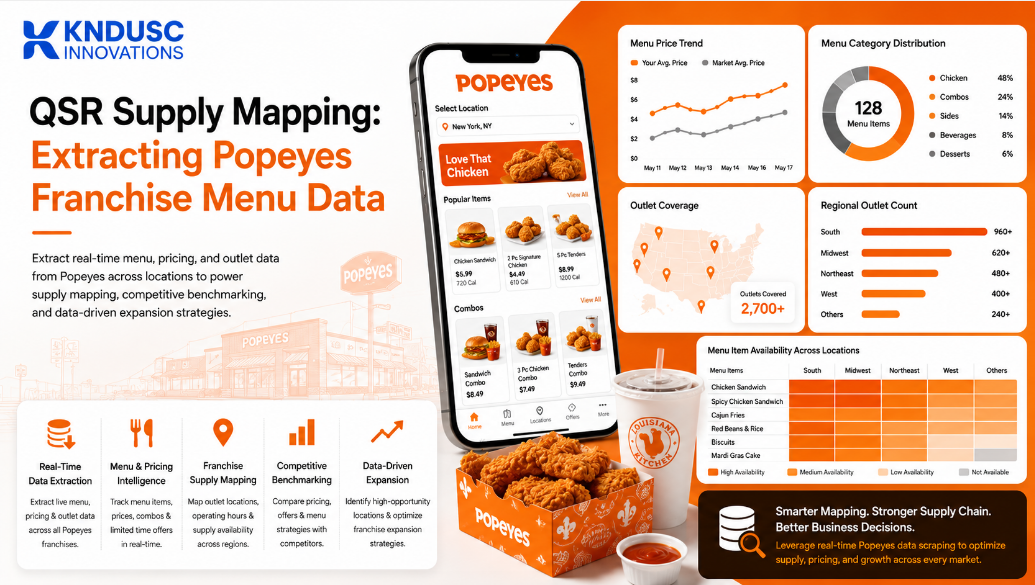
The quick-service restaurant (QSR) fried chicken segment operates with intense competitive pressure, tightly managed supply lines, and razor-thin operational margins. At the absolute forefront of this category's rapid global scaling is Popeyes Louisiana Kitchen. Driven by massive digital engagement and aggressive franchise expansion, Popeyes manages its operational footprint through a mix of corporate guidelines, independent franchise groups, and localized delivery configurations.
For poultry suppliers, direct fast-food competitors, commercial retail networks, and market analytics platforms, tracking this expansion manually is completely impossible. Menu parameters are entirely localized; individual item costs, combo deals, and real-time product availability change from store to store based on local franchise margins, distribution center storage limits, and hyper-local consumer demand.
  Traditional Crawler: Main Domain URL ──> Data Center IP ──> Static National Menu Placeholders
  KNDUSC Ingestion Engine: Target Store ID ──> App API Node ──> Live Store-Specific SKU & Price Feed
To optimize supply chains, benchmark restaurant profit margins, or design effective software for the food sector, analytical engines require clean, structured data streams straight from local stores. Relying on basic web scraping tools will result in immediate connection failures against modern app security.
Leveraging specialized data scraping and data extraction services allows enterprise teams to seamlessly pull live data blocks from these fast-moving digital layers. In this operational breakdown, we look at the precise data harvesting structures required to safely execute high-volume Popeyes menu data extraction.
Part I: Navigating the Digital Menu Architecture
To build a reliable data pipeline for QSR market tracking, your engineering team must identify exactly how modern food apps isolate and serve localized catalog arrays.
Hyper-Localized Franchise Pricing Variations
Popeyes grants individual franchise operators the flexibility to adjust local menu prices to offset regional labor rates, supply chain adjustments, and city-center commercial rents. A signature chicken combo or family meal can show notable price differences across separate locations within the exact same metropolitan hub. High-fidelity web crawlers must pass specific store identifier keys or exact GPS coordinates into session setup paths to capture genuine store-level menu structures.
Delivery Aggregator Markup Discrepancies
A significant portion of on-demand QSR revenue flows directly through third-party food delivery aggregators. Platforms routinely apply custom markups across separate delivery channels to offset commission percentages. For true market clarity, analysts must cross-examine data across multiple channels, matching the brand's direct app metrics side-by-side with external delivery aggregators.
Part II: Technical Obstacles to Automated Extraction
Extracting clean structured data from modern e-commerce and fast-food systems presents a major technical challenge for internal development teams. Popeyes protects its digital assets using robust, multi-layered network security.
1. Reverse-Engineering Mobile Application APIs
The vast majority of digital interactions occur within native mobile applications rather than open web directories. Menu listings, nutritional fields, and dynamic limited-time coupons load asynchronously via private, token-authenticated JSON APIs. Simple scripts trying to parse raw HTML strings from web sitemaps will return empty results. Resilient data collection requires intercepting and mimicking the application's underlying network signatures and header properties.
2. Behavioral Tracking and Browser Inspection
The platform's edge firewalls inspect incoming request traffic far beyond basic IP rate-limiting. They review deep browser handshakes, testing for mechanical request tempos, mismatched TLS ciphers, and missing metadata. When flagged, the server drops the connection instantly. Overcoming these filters requires using advanced headless automation tools configured to vary collection rhythms naturally.
Part III: Structuring Raw Inputs for Corporate Analytics
To feed predictive market analysis tools effectively, raw data harvested from deep application paths must clear a strict cleaning and normalization pipeline.
Target Ingestion Attributes for QSR Data Mining
| Target Ingestion Layer | Technical Target Components | Strategic Business Value |
|---|---|---|
| Menu Architecture | Core Item Titles, Universal SKU Identification, Category Mapping, Combo Surcharges | Automates broad catalog tracking and checks item assortment depth. |
| Localized Pricing | Base Item Cost, Combo Upgrade Surcharges, In-App Deal Reductions, Tax Inclusions | Informs dynamic pricing systems and tracks real-world franchise margins. |
| Logistics Availability | Local Store Hours, Real-Time Out-Of-Stock Indicators, Delivery Radius Thresholds | Spots supply line issues and uncovers localized product demand surges. |
| Nutritional Metrics | Allergen Classifications, Full Ingredient Deconstructions, Caloric Metrics | Automates compliance audits and feeds R&D product tracking models. |
Contextual Cross-Platform Mapping
For absolute strategic clarity, enterprise teams must evaluate localized restaurant metrics alongside parallel digital delivery streams. Our advanced data networks allow your business intelligence tools to review these insights side-by-side with your existing industry maps—whether auditing alternative fast-food footprints using our historic McDonald's menu data extraction analysis, tracking parallel food marketplace delivery networks via our specialized food delivery data scraping guide, checking individual delivery platform APIs through our Uber Eats restaurant menu pricing data analysis, or monitoring alternative global aggregators via our comprehensive Deliveroo scraper API pipeline.
Part IV: Fully Managed Data Infrastructure
Continually updating internal web crawlers to manage shifting mobile API schemas and variable geo-fencing structures is an expensive, continuous strain on internal engineering resources. When food delivery networks alter their front-end properties or validation headers, home-grown scripts fail instantly, cutting off critical strategic data feeds.
KNDUSC Innovations eliminates this resource drain entirely by offering a premium, end-to-end Data-as-a-Service (DaaS) model:
- Precision Geographic Targeting: We distribute extraction queries across premium residential and mobile carrier proxy meshes, accurately reflecting authentic consumer menus across targeted worldwide locations.
- Production Volume Delivery: Once your specific schema parameters are mapped, our systems scale seamlessly to volume, piping pristine data straight into your analytics infrastructure via custom api integrations, secure cloud storage options, or direct webhook connections.
Part V: Capitalize on Real-Time Market Intelligence
In the high-speed food and retail delivery channels, relying on lagging market indices or slow manual audits leaves your brand at an immediate disadvantage. Implementing automated web data extraction provides a real-time window into competitor price adjustments, localized assortment shifts, and shifting consumption trends.
Stop fighting with proxy errors, browser fingerprint bans, and broken scraping scripts. Partner with the data engineering specialists at KNDUSC Innovations to build a dependable, fully automated data pipeline configured precisely for your company's strategic goals.
Ready to harness deep restaurant market intelligence? Contact our strategy team today through our main solutions portal. Our senior data architects will assess your project scope and deliver a comprehensive data blueprint within one business hour.