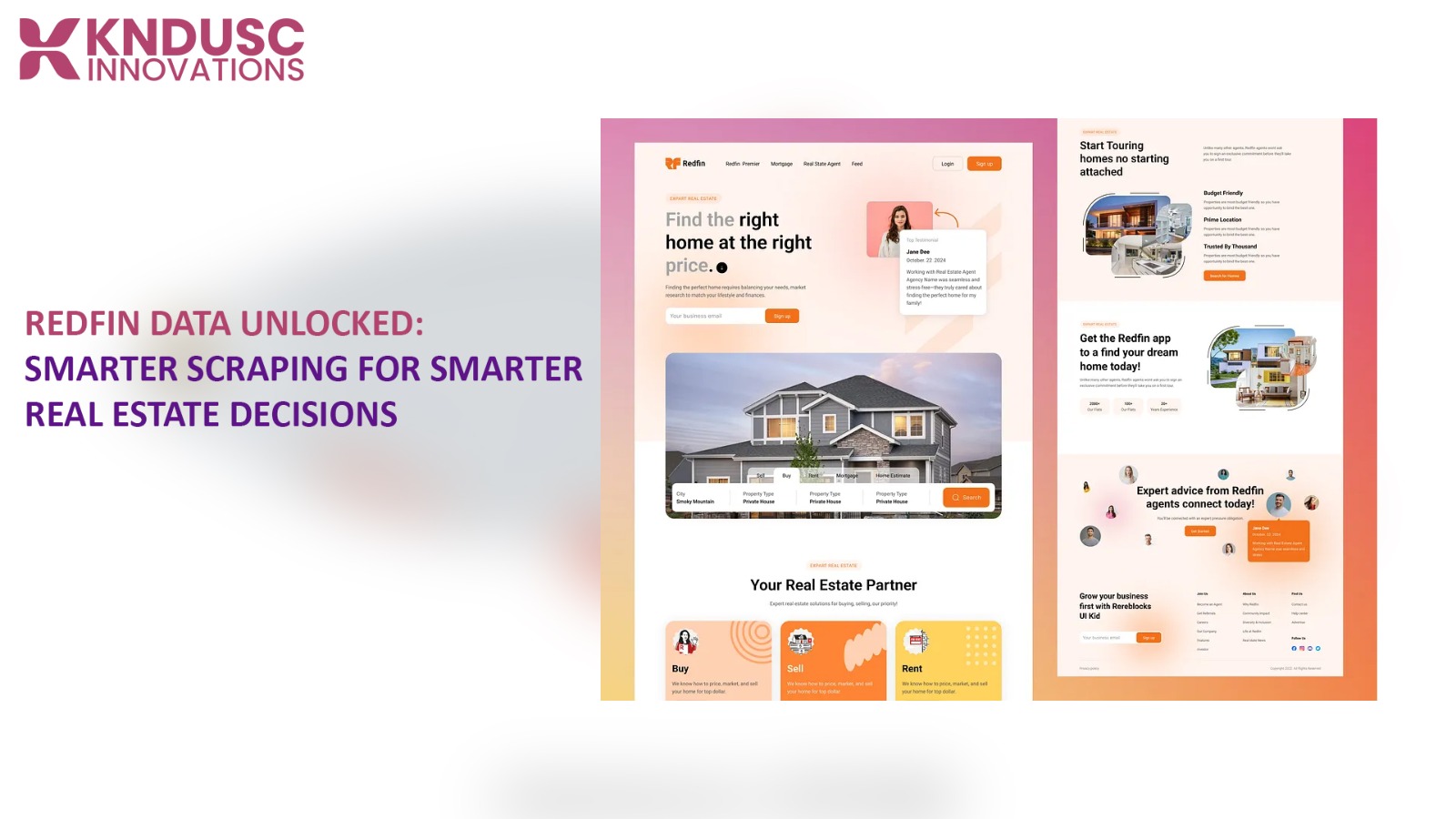
Redfin isn't just a listings portal, it's one of the most data-dense real estate platforms in North America. With millions of active and sold listings, proprietary demand scores, agent commission transparency, neighbourhood-level compete indexes, and an in-house AVM publishing Redfin Estimates per property, this platform holds structured intelligence that no manual research process can replicate at scale.
For real estate investors, PropTech platforms, mortgage lenders, and brokerage firms Redfin data scraping is the competitive edge hiding in plain sight. Extract it, structure it, and the US housing market becomes significantly easier to read and act on.
What Is Redfin Data Scraping?
Redfin data scraping is the automated extraction of publicly available real estate intelligence from Redfin's platform covering listing prices, Redfin Estimates, days on market, Hot Homes scoring, price drop history, agent commission data, sold prices, neighbourhood compete scores, school ratings, and climate risk indicators structured into clean, analytics-ready datasets.
Why Redfin specifically demands a purpose-built scraping approach:
- Listing prices differ by agent, zip code, and market heat the same property type can vary by 40%+ across metros
- Redfin Estimates update continuously generic crawlers miss daily valuation shifts
- Hot Homes scoring is a proprietary demand signal not available on Zillow, Realtor.com, or other portals
- Agent commission data is disclosed at listing level a uniquely extractable field for brokerage intelligence
- Sold price vs. asking price variance per property is only visible when both datasets are joined requiring cross-page extraction logic
Why Redfin Data Scraping Matters for Real Estate Businesses
The US real estate market doesn't wait. Listing prices shift overnight, inventory flips from active to pending within hours, and neighbourhood demand scores move week to week. Businesses still relying on manual research, delayed MLS exports, or quarterly market reports are always making decisions on yesterday's reality.
Redfin data scraping changes that equation entirely. Here's why it matters:
- Pricing decisions become evidence-based instead of estimating, you're working from live asking prices, Redfin Estimates, and real sold price comparables refreshed daily
- Investment opportunities surface faster automated extraction flags price drops, long-listed properties, and below-estimate listings before a competitor's analyst even opens their browser
- AVM accuracy improves significantly valuation models trained on stale data drift from market truth; structured Redfin data keeps them calibrated in real time
- Market blind spots disappear from zip-code-level compete scores to climate risk classifications, scraped Redfin data covers dimensions of a property that no single internal dataset can replicate
- Operational scale becomes possible screening 50 listings manually is a day's work; screening 50,000 with structured data is automated
In short, Redfin holds the intelligence. Scraping unlocks it. And the businesses that act on it fastest are the ones setting the terms not chasing them.
What Data Can Be Scraped from Redfin?
Active Listing Data
- Full address, zip code, county, MLS ID, and listing category
- Asking price, price per square foot, and original list price
- Bedrooms, bathrooms, garage spaces, and total interior square footage
- Lot size, year built, HOA fee, and property type classification
- Listing date, days on market, and Hot Homes designation
Pricing & Valuation Intelligence
- Redfin Estimate (AVM output) per individual property
- Full price change history reduction date, amount, and percentage
- Asking price vs. Redfin Estimate variance per listing
- Estimated monthly mortgage payment as published on listing page
- Price reduction count and cumulative reduction value over listing life
Sold Price & Transaction History
- Achieved sold price and closing date
- Listing price vs. sold price variance over/under asking percentage
- Prior transaction history per property address
- Property tax assessed value and annual tax bill
- MLS sale type standard, foreclosure, short sale, or auction
Neighbourhood & Location Intelligence
- Walk Score, Bike Score, and Transit Score per listing
- Redfin Compete Score by neighbourhood market hotness index
- School ratings elementary, middle, and high school proximity scores
- Flood zone, fire risk, heat risk, and wind risk classifications
- Nearby amenities scoring grocery, parks, hospitals within radius
Agent & Brokerage Data
- Listing agent name, license number, and brokerage affiliation
- Buyer's agent commission percentage where disclosed
- Agent's total active listings and average days to close
- Agent contact details and years active on Redfin platform
Market Trend Signals
- Median listing price and price per sqft by zip code and city
- Active inventory count and new listing volume week-over-week
- Average days to pending and median sale-to-list ratio by market
- Seasonal demand patterns by metro area
Real-Time Redfin Data: Sample Fields & Refresh Frequency
| Data Field | Example Value | Refresh Frequency |
|---|---|---|
| Asking Price | $874,000 | Daily |
| Redfin Estimate | $861,500 | Daily |
| Price Reduction | -$15,000 (Apr 1, 2026) | Daily |
| Days on Market | 12 days | Daily |
| Hot Homes Score | High — sells in ~9 days | Daily |
| Compete Score (Neighbourhood) | 82 / 100 | Weekly |
| Sold Price | $868,000 | Weekly |
| Walk Score | 91 — Walker's Paradise | Monthly |
| School Rating | 8/10 (Greatschools) | Monthly |
| Flood Risk | Minimal | Monthly |
| Agent Commission | 2.5% buyer's agent | Per listing |
| Property Tax (Annual) | $9,840 | Per listing |
Redfin vs. Competitor Portals Data Coverage Comparison
| Platform | Active Listings | AVM per Property | Compete Score | Agent Commission | Sold Price History | Hot Homes Signal |
|---|---|---|---|---|---|---|
| Redfin | ✅ Yes | ✅ Redfin Estimate | ✅ Yes | ✅ Disclosed | ✅ Yes | ✅ Yes |
| Zillow | ✅ Yes | ✅ Zestimate | ❌ No | ❌ No | ✅ Yes | ❌ No |
| Realtor.com | ✅ Yes | ✅ Basic | ❌ No | ❌ No | ✅ Limited | ❌ No |
| Homes.com | ✅ Yes | ❌ No | ❌ No | ❌ No | ❌ Limited | ❌ No |
Redfin's proprietary data layer Redfin Estimate, Compete Score, Hot Homes, and commission transparency — makes it the richest single-source real estate data platform for structured extraction in the US market.
Business Use Cases
1. Real Estate Investment Deal Scoring — Extract Redfin price drop data and Estimate gaps to surface motivated seller opportunities automatically
Stop manually browsing listings. Let structured Redfin data surface the deals.
- Monitor listings where asking price exceeds Redfin Estimate by 5%+ a negotiation signal
- Flag properties with 3+ price reductions and 45+ days on market in target zip codes
- Track new listings going live within minutes of Redfin publishing in high-demand metros
- Calculate estimated cap rate by combining asking price with rental market benchmarks
- Score opportunities by Compete Score and school rating to prioritise acquisition shortlists
2. Automated Valuation Model Training — Scrape Redfin Estimate vs. sold price variance data for PropTech AVM calibration
Every AVM is only as accurate as the data it's trained on.
- Pull Redfin Estimate and achieved sold price per property to build variance training datasets
- Refresh AVM inputs daily across priority markets to reflect live pricing movements
- Cross-reference property features sqft, beds, baths, year built with sold price outcomes
- Use climate risk data fields to test risk-adjusted valuation model performance
- Reduce AVM lag caused by reliance on delayed county records alone
3. Brokerage Competitive Pricing Intelligence — Redfin listing price monitoring by zip code for agent pricing strategy and vendor advisory
Price a listing right the first time with live market evidence, not gut feel.
- Monitor active comps by property type, bedrooms, and zip code updated daily
- Track competitor listing reductions a clear signal of overpricing in the local market
- Alert agents the moment a comparable property goes pending or closes
- Benchmark proposed listing prices against neighbourhood median and Redfin Estimate
- Use days-to-pending trend data by zip to set accurate vendor expectation timelines
4. Mortgage & Lending Desktop Valuation Support — Redfin sold price and listing data scraping for rapid pre-approval due diligence workflows
Reduce underwriting time without sacrificing valuation accuracy.
- Cross-reference borrower-stated property values against Redfin live asking prices
- Pull sold price comparables within 0.5 miles, same property type, and similar sqft bands
- Flag listings with repeated reductions as potential overvaluation risk signals
- Monitor days-on-market by property type and zip as a local liquidity risk indicator
- Use climate risk scores for collateral risk assessment in flood and fire-prone areas
5. iBuyer & Institutional Acquisition Screening — Scrape Redfin property data at national scale to filter thousands of listings against acquisition criteria
Scale deal screening without scaling headcount.
- Filter active listings by cap rate estimate, price per sqft, lot size, and HOA threshold
- Build metro-level heat maps of acquisition activity using Redfin sold price feed
- Score neighbourhoods by Compete Score, school rating, and walkability for portfolio fit
- Monitor builder activity in target markets through new construction listing streams
- Set automated alerts when new listings in target zip codes match acquisition parameters
6. Rental Yield & Buy-to-Rent Analysis — Redfin for-rent listing data extraction for buy-to-rent investment yield modelling by US zip code
Know the yield before you make the bid.
- Extract Redfin rental listings by zip, property type, and bedroom count daily
- Combine asking rent with active for-sale prices to calculate gross yield per zip code
- Track rental price trends quarter-over-quarter to identify appreciating rental markets
- Compare rental days-on-market to identify undersupplied submarkets with strong demand
- Use school ratings and transit scores to weight yield analysis by tenant demand quality
7. Corporate Relocation & Destination Market Advisory — Redfin neighbourhood data scraping for employee relocation housing market intelligence
Match relocating employees to housing markets aligned with their lifestyle and budget — fast.
- Pull walk score, transit score, and school rating data per neighbourhood for comparison
- Compare median listing prices and rental rates across 20+ target US metros simultaneously
- Monitor active inventory levels in destination cities for realistic placement timelines
- Track listing price trends to advise employees on optimal market entry timing
- Use climate risk scores to flag flood and fire-prone areas in relocation shortlists
Redfin Property Intelligence Dataset for reference
| Property ID | Address | Metro | Type | Beds | Asking Price ($) | Price/sqft ($) | Redfin Estimate ($) | Days Listed | Compete Score | Status |
|---|---|---|---|---|---|---|---|---|---|---|
| RF001 | 412 Maple Ave, Austin TX 78701 | Austin | Single-Family | 4 | 875,000 | 412 | 862,000 | 8 | 82 | Active |
| RF002 | 89 Ocean Dr, Miami FL 33139 | Miami | Condo | 2 | 650,000 | 748 | 638,000 | 22 | 74 | Active |
| RF003 | 1140 Pine St, Seattle WA 98101 | Seattle | Townhouse | 3 | 795,000 | 524 | 810,000 | 5 | 91 | Pending |
| RF004 | 55 Lakeview Blvd, Chicago IL 60614 | Chicago | Multi-Family | 6 | 1,200,000 | 287 | 1,175,000 | 34 | 63 | Active |
| RF005 | 302 Elm St, Denver CO 80203 | Denver | Single-Family | 3 | 589,000 | 368 | 602,000 | 11 | 79 | Active |
| RF006 | 77 Market St, San Francisco CA 94105 | SF Bay Area | Condo | 1 | 720,000 | 1,042 | 695,000 | 48 | 56 | Price Drop |
| RF007 | 215 Riverside Dr, Nashville TN 37201 | Nashville | Townhouse | 3 | 472,000 | 294 | 485,000 | 7 | 85 | Active |
| RF008 | 930 Highland Ave, Atlanta GA 30306 | Atlanta | Single-Family | 4 | 648,000 | 318 | 655,000 | 13 | 77 | Active |
| RF009 | 14 Harbor Ln, Boston MA 02110 | Boston | Condo | 2 | 895,000 | 862 | 880,000 | 19 | 88 | Active |
| RF010 | 501 Desert Rose Ct, Phoenix AZ 85001 | Phoenix | Single-Family | 5 | 540,000 | 248 | 528,000 | 26 | 68 |
What Smart Real Estate Businesses Are Searching For
The most data-forward businesses in the US property sector aren't searching for generic Redfin listings — they're searching for specific intelligence capabilities.
Pricing & Valuation
- How to extract Redfin listing prices by zip code and property type at scale
- How to track Redfin price reductions by metro area automatically
- How to compare Redfin Estimates against closed sale prices for AVM training
- How to build a US housing price index using live Redfin data feeds
Investment & Rental Analytics
- How to scrape Redfin rental listings to calculate buy-to-rent yield by zip code
- How to identify below-market listings using Redfin Estimate gap analysis
- How to model neighbourhood appreciation potential using Redfin sold price history
- How to filter Redfin listings by climate risk score and school rating for investment scoring
Market Monitoring
- How to get real-time new listing alerts from Redfin for target zip codes
- How to monitor days-on-market trends across US metros for liquidity analysis
- How to track Redfin Compete Scores by neighbourhood over time
- How to compare Redfin inventory levels quarter-over-quarter by city
Common Redfin Data Extraction Challenges — and How They're Solved
| Challenge | Business Impact If Ignored | How It's Resolved |
|---|---|---|
| JavaScript-rendered listing pages | Incomplete fields, missing Redfin Estimates | Headless browser rendering pipeline |
| IP blocking and rate limiting | Extraction failure at national scale | Rotating residential proxy networks |
| Duplicate MLS entries across geographies | Inflated dataset, skewed analysis | Automated cross-market deduplication logic |
| Listing status changes mid-crawl | Stale active/sold classification in dataset | Real-time status delta sync |
| Irregular price and sqft formatting | Downstream calculation errors in AVM models | Field normalization and validation pipeline |
| Climate and school data on separate pages | Incomplete location intelligence per listing | Multi-page extraction and field joining logic |
Why Choose KNDUSC for Managed Redfin Data
Building an internal Redfin scraping operation looks manageable until the first time Redfin's front-end structure updates and every crawler breaks simultaneously. KNDUSC's managed service eliminates that fragility entirely.
- No infrastructure maintenance KNDUSC runs proxy pools, browser rendering clusters, and refresh schedulers without your engineering team touching them
- Data quality guaranteed KNDUSC's normalization, deduplication, and validation pipelines deliver analytics-ready output, not raw HTML
- Custom field mapping data delivered in your schema, mapped precisely to your downstream systems — not a generic one-size-fits-all format
- Compliance handled KNDUSC's ethical extraction practices and GDPR/CCPA-aligned data handling are built in from day one
- Scale on demand expand from 5 zip codes to 500 metro markets without rebuilding a single pipeline
- Redfin Data Delivered by KNDUSC Format Options
| Format | Best For |
|---|---|
| JSON / REST API | Real-time AVM engines, PropTech platforms |
| CSV / Excel | Analyst teams, investment desks |
| Database push | Enterprise data warehouses, BI pipelines |
| Custom schema | Power BI, Tableau, Snowflake integrations |
The US housing market moves listing by listing, hour by hour. KNDUSC makes sure your data intelligence does too.
Redfin publishes thousands of new listings, price changes, status updates, and valuation shifts every single day. The investors, platforms, and brokerages making the sharpest real estate decisions in 2026 are the ones powered by KNDUSC's structured, continuously refreshed Redfin data not the ones refreshing browser tabs manually.
Stop guessing on listings. Start deciding on data.
👉 Request a Free Redfin Data Sample from KNDUSC — structured, clean, and delivery-ready 📩 Talk to a KNDUSC Real Estate Data Expert — Book a Free Strategy Call
KNDUSC builds flexible pipelines for PropTech platforms, investment firms, brokerages, mortgage lenders, iBuyers, and market research teams. No lock-in. No data gaps. Just live Redfin intelligence delivered your way.
Frequently Asked Questions
1. What is Redfin data scraping?
Redfin data scraping is the automated extraction of publicly available property data from Redfin including asking prices, Redfin Estimates, sold prices, agent details, neighbourhood scores, and market trend signals structured by KNDUSC into clean datasets for real estate analytics, investment modeling, and platform development.
2. What makes Redfin data more valuable than other US portal data?
Redfin publishes proprietary signals unavailable on other portals including the Redfin Estimate per property, Hot Homes demand scoring, neighbourhood Compete Scores, and buyer's agent commission transparency. KNDUSC extracts and structures this layered intelligence, making it the richest publicly accessible US real estate data source for your business.
3. How often is Redfin data refreshed in a KNDUSC pipeline?
Asking prices and listing status changes refresh daily for priority markets. Sold prices and neighbourhood scores update weekly or monthly KNDUSC configures refresh cadence to match your exact operational requirements.
4. Is Redfin data scraping legal?
KNDUSC extracts only publicly visible listing data the same information any browser user sees on Redfin. Businesses should ensure usage complies with applicable US data privacy regulations and Redfin's terms of service. Always consult legal counsel for commercial deployments.
5. Can Redfin data integrate with existing platforms and dashboards?
Yes. KNDUSC delivers data via REST API or structured file formats JSON, CSV, Excel designed for direct integration with valuation engines, CRM systems, BI dashboards, and data warehouse environments with minimal setup overhead.
6. Can I get Redfin data filtered by specific zip codes and property types?
Yes. KNDUSC configures extraction by zip code, city, metro area, property type, bedroom count, price band, listing status, and any combination of available fields fully tailored to your target markets.
7. Who uses KNDUSC's structured Redfin data extraction services?
Real estate investors, PropTech platforms, residential brokerages, mortgage lenders, iBuyers, institutional buyers, corporate relocation firms, and real estate research organizations all use KNDUSC's continuously updated Redfin property intelligence to make faster, more accurate decisions.