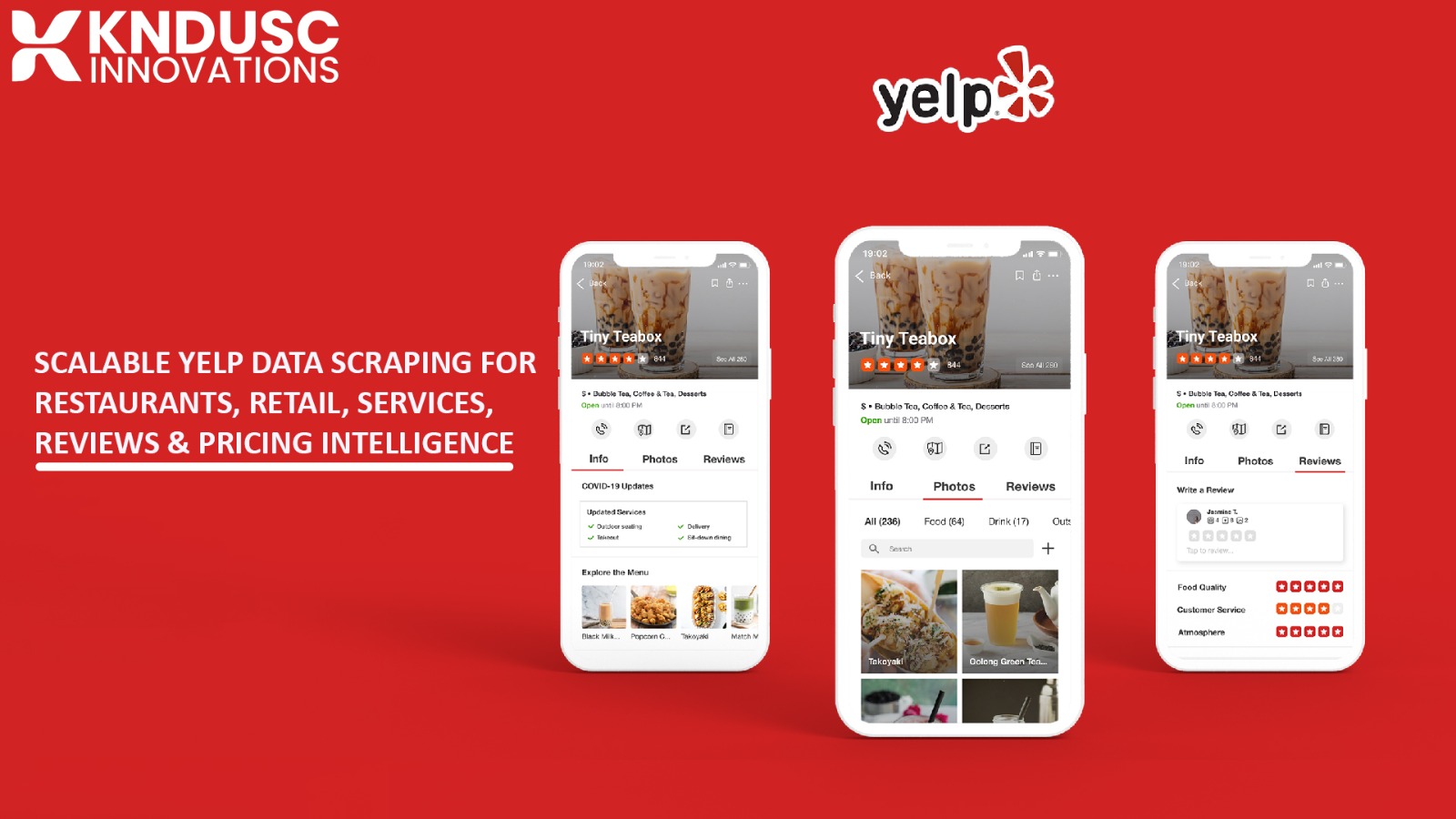
Yelp sits at the intersection of consumer trust and business intelligence. With over 287 million reviews spanning restaurants, retail stores, healthcare providers, and local services, it is one of the most commercially rich public datasets available online yet most businesses are not extracting it systematically. Those that do gain a decisive edge in pricing, positioning, and market expansion that competitors relying on manual research simply cannot replicate.
Yelp data scraping services enable businesses to collect this intelligence programmatically extracting star ratings, review text, price range signals, business attributes, and competitor positioning data at scale, and converting raw listings into structured datasets that fuel pricing engines, sentiment dashboards, and market intelligence platforms across every consumer-facing industry.
Yelp Data Scraping Defined
Yelp data scraping is the automated extraction of publicly available business and review information from Yelp's platform including business names, addresses, phone numbers, operating hours, category classifications, star ratings, review volumes, review text, price tier indicators, and business attribute flags structured into formats ready for analytics platforms, pricing models, CRM systems, and intelligence dashboards.
It enables restaurant chains, retail brands, marketing agencies, real estate developers, and technology platforms to monitor consumer sentiment, benchmark competitors, and track local market dynamics continuously without manual research effort or dependence on Yelp's commercially restricted API.
Why Yelp Remains the Most Valuable Local Business Data Source in North America
Yelp commands a unique position in the local business intelligence landscape. Restaurants alone account for approximately 17% of all Yelp reviews a figure that translates to nearly 49 million restaurant-specific data points covering cuisine categories, dining experiences, service quality, and price perception across every major US city and suburban market.
What makes Yelp structurally different from Google Maps or TripAdvisor is the depth of its review text and the specificity of its business attributes. Each listing carries price range signals ($–$$$$), service tags, ambience descriptors, health and safety attributes, and verified photo counts layered intelligence that no other single platform replicates with the same granularity for the US and Canadian markets.
As of 2025, AI overviews appear in 68% of local search results and those overviews pull directly from Yelp review content, ratings, and business attributes. Businesses with stronger Yelp data footprints are surfaced first. Monitoring and benchmarking that data in real time is now a search visibility strategy, not just a reputation management exercise.
Market signal: Yelp's 2025 food and drink trend report identified a 501% year-over-year rise in "mushroom drink" searches and surging demand for "solo dining" and "unique dining experiences." These are the kinds of emerging demand signals that structured Yelp data extraction surfaces months before they appear in industry reports.
What Data Can Be Extracted from Yelp at Scale?
A comprehensive Yelp scraping pipeline captures intelligence far beyond the headline rating. Every layer of a Yelp listing — from the business profile to individual review metadata carries commercially actionable signals when extracted and structured at scale.
Business Identity & Classification
Full business name, verified address, and ZIP code or postal code
Primary and secondary category classifications cuisine type, service vertical, industry tag
Phone number, website URL, and claimed/unclaimed listing status
Operating hours by day, holiday hours where published, and temporarily closed flags
Neighbourhood and district tags used by Yelp's search ranking algorithm
Ratings, Reviews & Sentiment Signals
Overall star rating to one decimal point and total review count
Individual review text with date stamp, reviewer profile, and star rating per review
Reviewer metadata Elite status, review count, follower count, and location
Review reaction counts Useful, Funny, and Cool signals as engagement proxies
Photo count per listing as a visual engagement and quality indicator
Pricing & Business Attribute Intelligence
Price tier classification $ through $$$$ as a relative positioning signal
Service attributes delivery, takeout, dine-in, outdoor seating, reservations, Wi-Fi
Ambience tags casual, romantic, trendy, upscale, divey as positioning intelligence
Health and safety certifications and accessibility features where published
Transaction-level tags Good for groups, Good for kids, Parking availability
How to Scrape Yelp Data: The End-to-End Process
Step 1 — Define Target Scope and Data Requirements
Before any extraction begins, target geographies, business categories, and specific data fields are scoped. This means selecting ZIP codes or city-level markets, restaurant or service sub-categories, and the precise data fields rating, review text, pricing, hours, attributes required for your downstream use case.
Step 2 — Configure Crawlers for Listings and Search Pages
Automated crawlers navigate Yelp's category search pages, geographic result sets, and individual business profile pages — extracting structured data from each listing. For large-scale operations across multiple cities and verticals, concurrent crawlers partition work across geographic segments simultaneously.
Step 3 — Handle JavaScript Rendering and Anti-Scraping Measures
Yelp renders significant portions of its business data through JavaScript frameworks. Professional scraping infrastructure handles this through headless browser rendering, rotating proxy pools, and request throttling ensuring complete data extraction without triggering platform-level blocking or CAPTCHA challenges.
Step 4 — Clean, Deduplicate, and Structure the Data
Raw extracted data contains irregularities inconsistent price format notation, duplicate listings across categories, encoding variations in review text, and missing field values. A validation and normalisation pipeline standardises the dataset before output, ensuring every record is analytics-ready rather than requiring downstream transformation.
Step 5 — Deliver via API or Structured File Export
Cleaned Yelp business and review data is delivered through REST APIs for real-time integration or as structured file exports in JSON, CSV, or Excel formats feeding directly into sentiment dashboards, CRM systems, pricing engines, and business intelligence platforms.
Step 6 — Schedule Ongoing Refresh Cycles
Review volumes, ratings, and business attributes change continuously. Automated refresh cycles daily for priority markets, weekly for broader geographic coverage ensure the dataset remains current, accurate, and actionable for real-time competitive monitoring.
Yelp Data Scraping Coverage: Business Categories & Data Fields
| Data Category | Key Fields Extracted | Extraction Scope | Primary Business Use | Refresh Frequency |
|---|---|---|---|---|
| Restaurant Listings | Name, cuisine, rating, reviews, price tier, hours | All US & Canada markets | Competitor benchmarking, market mapping | Daily |
| Review Text & Sentiment | Review body, date, star rating, reviewer metadata | All business categories | Sentiment analysis, NLP training data | Daily |
| Pricing Intelligence | $ to $$$$ tier, menu price signals where listed | Restaurants & retail | Pricing strategy, market positioning | Weekly |
| Business Attributes | Delivery, takeout, seating, parking, Wi-Fi | All categories | Feature benchmarking, lead qualification | Weekly |
| Retail & Services Listings | Category, rating, hours, address, attributes | All retail & services | Market entry analysis, directory building | Weekly |
| Reviewer Intelligence | Elite status, review count, follower count | All categories | Influencer identification, trust scoring | Weekly |
| Photo & Engagement Data | Photo count, check-in count, Useful/Funny/Cool | All business listings | Engagement benchmarking, brand presence | Monthly |
| Geographic & Neighbourhood Data | ZIP, neighbourhood tag, district classification | US & Canada ZIP level | Location intelligence, expansion planning | Monthly |
Yelp vs Competitor Platforms: Data Scraping Comparison
Selecting the right review platform to extract depends on your industry vertical, target geography, and the depth of intelligence required. Here is how Yelp compares against the four most commonly used alternatives for data scraping and business intelligence purposes:
| Feature | Yelp | Google Maps | TripAdvisor | Foursquare | OpenTable |
|---|---|---|---|---|---|
Restaurant review depth (US) | ✔ Excellent | ~ Good | ~ Moderate | ✘ Limited | ~ Moderate |
Review text length & detail | ✔ Very deep | ~ Short | ✔ Deep | ✘ Tips only | ~ Moderate |
Price tier data | ✔ $ – $$$$ | ✔ Yes | ~ Limited | ~ Tip-based | ✔ Yes |
Business attribute richness | ✔ Very rich | ~ Moderate | ~ Travel-focused | ✘ Basic | ~ Dining only |
Retail & services data | ✔ Full coverage | ✔ Full coverage | ✘ Travel only | ~ Some | ✘ Dining only |
Global geographic coverage | ✘ US & Canada | ✔ Global | ✔ Global | ✔ Global | ~ Limited |
Sentiment signal quality | ✔ Best in class | ~ Moderate | ✔ Strong | ✘ Weak | ~ Moderate |
Anti-scraping complexity | ~ Medium | High (API model) | ~ Medium | Low (API) | ~ Medium |
Free API access | ✘ Paid only | ~ Limited free tier | ✔ Free key | ~ Limited | ✘ Paid |
Best use case | US restaurants & services | Global at scale | Travel & hospitality | Location analytics | Dining reservations |
For businesses focused on the US restaurant, retail, and local services market, Yelp delivers the deepest review data, the richest business attribute layer, and the most commercially useful sentiment signals of any platform. Google Maps wins on global scale. TripAdvisor excels in travel. Foursquare is better leveraged through its API than through scraped review content.
Sample Dataset: Yelp Restaurant Listings — Structured Data Output
The table below represents a sample of the structured dataset output delivered by a Yelp scraping pipeline for restaurant listings across a single city market illustrating the fields, format, and data depth available at scale:
| # | Business Name | Category | City | Rating | Reviews | Price Tier | Delivery | Outdoor Seating | Status |
|---|---|---|---|---|---|---|---|---|---|
| 1 | Calabria Kitchen | Italian, Pizza | Chicago, IL | 4.8 | 2,341 | $$$ | ✔ | ✔ | Active |
| 2 | Seoul Garden | Korean, BBQ | Los Angeles, CA | 4.6 | 1,876 | $$ | ✘ | ~ | Active |
| 3 | Spice Route | Indian, Halal | New York, NY | 4.4 | 3,102 | $ | ✔ | ✘ | Active |
| 4 | The Brunch Collective | American, Brunch | Austin, TX | 4.7 | 894 | $$$ | ✘ | ✔ | Active |
| 5 | El Molino Verde | Mexican, Vegan | San Francisco, CA | 4.3 | 1,245 | $$ | ✔ | ✔ | Active |
| 6 | Umami Ramen House | Japanese, Ramen | Seattle, WA | 4.9 | 4,567 | $$ | ✘ | ✘ | Active |
| 7 | Harbor Smoke & Grill | BBQ, American | Miami, FL | 4.2 | 712 | $$$ | ✔ | ✔ | Active |
| 8 | Green Plate Café | Vegan, Healthy | Denver, CO | 4.5 | 521 | $$ | ✔ | ~ | Active |
| 9 | Bistro Parisienne | French, Wine Bars | Boston, MA | 4.7 | 1,034 | $$$$ | ✘ | ✔ | Active |
| 10 | Taco Tierra | Mexican, Fast Food | Houston, TX | 4.1 | 2,890 | $ | ✔ | ✘ | Active |
✔ Available · ✘ Not available · ~ Third-party / partial
Business Use Cases: How Industries Leverage Yelp Data
1. Restaurant Chain Expansion & Location Intelligence
Multi-location restaurant operators use Yelp density mapping to evaluate new market entry identifying ZIP codes with high consumer demand, low competitive saturation, and strong review velocity before committing to a lease. This turns gut-feel expansion decisions into data-backed site selection intelligence.
Review text analysis across existing competitors surfaces the most-mentioned pain points slow service, limited vegetarian options, inconsistent quality creating a blueprint for positioning that directly addresses what the local market wants but currently isn't getting.
2. Retail Pricing Strategy and Competitor Monitoring
Retail brands extract Yelp price tier signals and review text to understand how competitors are perceived on value not just what they charge, but how customers feel about what they pay. Review phrases like "overpriced for the quality" or "incredible value" are pricing intelligence that no survey replicates.
Weekly monitoring of competitor rating changes, new review volume, and attribute additions signals market moves a competitor adding delivery, updating hours, or dropping a price tier before those changes appear in any other intelligence source.
3. Marketing Agency Lead Generation and Pitch Intelligence
Marketing agencies targeting local business clients use Yelp scraping to build prospect lists filtered by rating trajectory identifying businesses whose ratings are declining, whose review response rates are low, or whose competitor set is pulling ahead on review volume. Each of these signals is a buying trigger for reputation management and local SEO services.
4. Real Estate and Franchise Site Selection
Property developers and franchise expansion teams pull Yelp business density, category mix, and average rating data at ZIP code level to evaluate foot traffic potential and neighbourhood commercial health. A block with three 4.5-star restaurants and rising review velocity tells a very different investment story than one with declining ratings and closure patterns.
5. Hospitality and Travel Intelligence Platforms
Travel platforms and hospitality technology businesses use Yelp review and rating data to enrich destination guides, power recommendation engines, and feed quality scoring models. Yelp's restaurant data specifically fills geographic gaps where TripAdvisor coverage is thinner — particularly in secondary US cities and suburban markets.
6. Healthcare and Professional Services Market Research
Beyond food and retail, Yelp's professional services and healthcare provider listings carry star ratings, review text, and attribute data that market researchers, insurance platforms, and directory businesses use to build quality-ranked service provider databases across medical, dental, legal, and home services verticals.
Ready to Extract Yelp Intelligence for Your Business?
KNDUSC delivers clean, structured Yelp datasets — updated daily — for restaurants, retail, services, and beyond.
Request a Demo →Get a Custom Quote
Challenge: A Restaurant Chain's Blind Spot on Competitor Intelligence
A 60-location fast-casual restaurant brand operating across the US Midwest was experiencing flat same-store sales despite increased marketing spend. The brand's leadership suspected competitive pressure from new entrants and shifting consumer preferences but had no structured view of what was happening at the competitor listing level across their markets.
Key gaps included no visibility into competitor rating changes by city and category, no access to review text patterns that might reveal shifting consumer priorities, no pricing intelligence on how competitors were positioned in the $ to $$$$ tier relative to their own locations, and no ability to track which competitor locations were gaining review velocity a leading indicator of foot traffic growth.
The brand needed a managed Yelp data extraction solution covering their 60 markets continuously delivering structured competitive intelligence into their analytics dashboard without requiring internal scraping infrastructure or data engineering overhead.
Solution: Managed Yelp Data Pipeline Deployment
A fully managed Yelp data scraping and API delivery pipeline was deployed to extract, clean, and deliver structured competitive and consumer intelligence directly into the brand's analytics infrastructure.
Geographic Coverage: All 60 active markets plus 15 planned expansion markets covering restaurant listings, review data, pricing signals, and attribute intelligence for the brand's direct category competitors within a 3-mile radius of each location.
Data Streams Delivered: Daily competitor rating and review volume monitoring, weekly price tier and attribute change alerts, monthly review sentiment analysis by keyword cluster surfacing the most-mentioned positives and negatives across competitor review sets and expansion market scoring using review density, rating distribution, and category saturation metrics.
Results Achieved: The brand identified three markets where a single competitor was generating disproportionate review velocity enabling targeted promotional response within those ZIP codes before the competitive gap widened further. Review sentiment analysis revealed "portion size" and "wait time" as the two highest-frequency negative themes across competitor reviews in their category informing operational adjustments that addressed what the market was already vocal about wanting. Expansion market scoring deprioritised two planned city entries where category saturation and competitor rating strength suggested lower opportunity and elevated two markets the team had initially ranked lower.
What Businesses Are Searching For
The most competitive businesses in the restaurant, retail, and local services space are not searching for generic "Yelp data" they are searching for specific intelligence capabilities that structured extraction makes possible.
Restaurant & Food Service Intelligence
How to extract Yelp restaurant listings by cuisine type and city at scale
How to scrape Yelp reviews for restaurant competitor sentiment analysis
How to track Yelp star rating changes for restaurant chains weekly
How to identify trending restaurant categories using Yelp review volume data
How to compare Yelp price tiers across competitor restaurant sets by ZIP code
Retail & Services Market Intelligence
How to scrape Yelp business listings for retail market mapping
How to extract Yelp service business attributes for lead generation
How to monitor Yelp competitor ratings for local service businesses in real time
How to build a business directory database from Yelp listings by category and region
Platform & Technology Requirements
How to integrate Yelp business data into CRM and analytics platforms
How to get structured Yelp data delivered in JSON or CSV via API
How to bypass Yelp's anti-scraping measures for large-scale data extraction
What is the best Yelp API alternative for bulk review data extraction
How to scrape Yelp without getting blocked or rate-limited
Why Choose KNDUSC for Yelp Data Scraping and Local Business Intelligence?
KNDUSC delivers scalable Yelp data scraping, local business intelligence APIs, and review data pipeline solutions designed for the operational demands of restaurant chains, retail brands, marketing agencies, real estate firms, and technology platforms requiring structured, continuously refreshed Yelp data at scale.
National US & Canada Coverage Business and review data extracted across all major cities, suburban markets, and ZIP code clusters for restaurants, retail, services, healthcare, and hospitality verticals.
Daily & Real-Time Refresh Schedules Rating and review data refreshed daily for priority markets. Attribute and pricing data refreshed weekly. Custom refresh frequencies configured to your operational requirements.
Structured, Analytics-Ready Output All Yelp data is cleaned, validated, deduplicated, and delivered in API-native JSON or structured file formats ready for direct ingestion into sentiment dashboards, pricing engines, CRM systems, and BI platforms.
Dynamic Content & Anti-Block Handling KNDUSC's infrastructure manages Yelp's JavaScript-rendered pages through headless browser technology, rotating proxy networks, and intelligent throttling ensuring complete, reliable extraction at scale.
Custom Data Schemas Yelp data requirements vary by business model. KNDUSC designs extraction and delivery pipelines mapped precisely to your field requirements, schema architecture, and downstream system integrations.
GDPR-Compliant & Ethical Extraction All operations respect data privacy requirements, applicable terms of service constraints, and US and international data protection regulations across every data collection activity.
Power Your Intelligence Operations with Yelp Data
Whether you are benchmarking competitors, identifying expansion markets, or building a review sentiment platform — KNDUSC's managed Yelp data pipeline gives you the structured, continuously updated intelligence your business needs to move faster than the market.
Contact KNDUSC →Explore Food & Delivery Solutions
Frequently Asked Questions
1. What is Yelp data scraping?
Yelp data scraping is the automated extraction of publicly available business and review information from Yelp's platform including star ratings, review text, price tiers, operating hours, business attributes, and competitor positioning data structured into analytics-ready datasets for restaurant intelligence, retail market research, and local services monitoring.
2. Is it legal to scrape data from Yelp?
Yelp data scraping operates on publicly accessible business and review information. Businesses should ensure extraction activities comply with Yelp's terms of service, applicable US and international data privacy laws, and GDPR requirements for EU-resident reviewer data. KNDUSC follows ethical scraping practices and legal compliance standards across all data operations.
3. What types of data can be extracted from Yelp at scale?
Extractable data includes business names, addresses, phone numbers, categories, star ratings, review counts, full review text, reviewer metadata, price tier classifications, service attributes, photo counts, operating hours, and neighbourhood classification tags across restaurants, retail, healthcare, professional services, and hospitality verticals.
4. How frequently is Yelp business and review data refreshed?
Refresh frequency is configured to operational requirements. Rating and review data for priority markets can be refreshed daily. Business attributes and pricing signals are typically refreshed weekly. Broader geographic coverage is refreshed on weekly or bi-weekly schedules depending on market volatility.
5. How does Yelp data scraping support competitor analysis?
Structured Yelp data enables businesses to track competitor rating changes week-over-week, monitor review volume growth as a foot traffic proxy, analyse review text sentiment by keyword to identify competitor strengths and weaknesses, compare price tier positioning across competitor sets, and detect new attribute additions such as delivery or outdoor seating before they appear in any other intelligence source.
6. Can Yelp data be integrated with existing business systems?
Yes. KNDUSC delivers Yelp business and review data via REST APIs and structured file formats including JSON, CSV, and Excel designed for direct integration with CRM platforms, analytics dashboards, pricing engines, and data warehouse environments with minimal engineering overhead.
7. How does Yelp scraping differ from using the Yelp Fusion API?
The Yelp Fusion API requires paid subscription access, delivers a limited subset of data fields compared to what is publicly visible on the platform, and applies strict rate limits on request volume. Managed scraping services provide broader data coverage including full review text, reviewer metadata, and attribute detail with faster refresh cycles and without dependency on API tier restrictions.
8. Which industries benefit most from Yelp data scraping services?
Restaurant chains, retail brands, marketing agencies, real estate developers, franchise expansion teams, hospitality technology platforms, healthcare directory businesses, and professional services market research firms are the primary beneficiaries of structured Yelp data extraction at scale.


