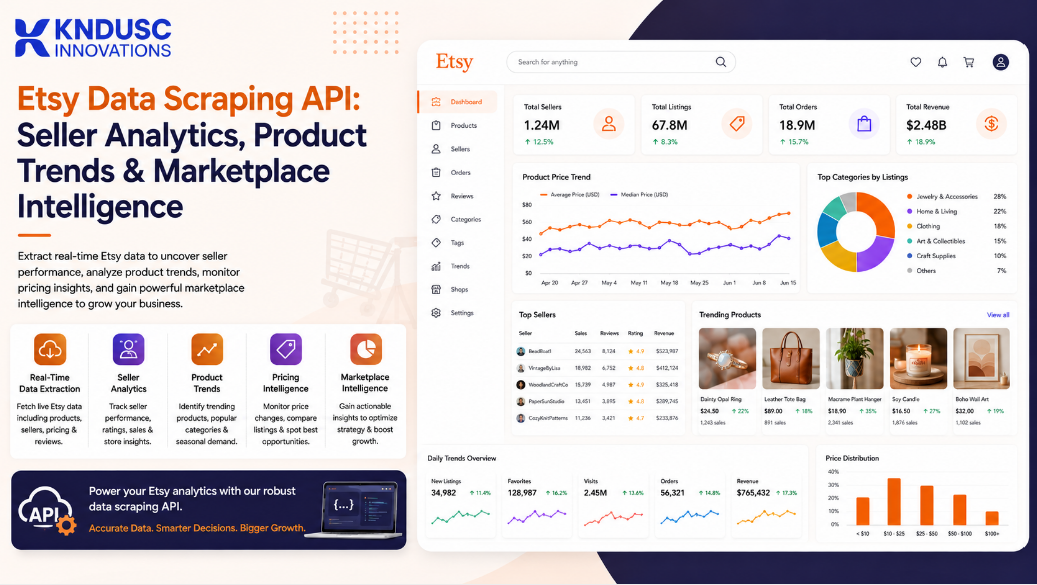
The global e-commerce landscape for unique, vintage, and handmade goods is massive, and Etsy sits right at the center of it. With millions of active listings and independent storefronts, it is a goldmine of commercial data. For e-commerce brands, retail arbitrage software, and market intelligence platforms, tapping into this data via Etsy data scraping is no longer optional—it is a core strategy for survival and growth.
Using a scalable Etsy scraper API, enterprises can bypass manual market research and extract highly structured datasets. This guide explores how automated data extraction unlocks deep seller analytics, competitive pricing intelligence, and predictive trend forecasting on Etsy.
What is Etsy Data Scraping?
Featured Snippet:
Etsy data scraping helps businesses extract product listings, pricing, seller details, reviews, ratings, and marketplace trends from Etsy at scale. Ecommerce brands and analytics companies use Etsy scraping APIs for competitor intelligence, pricing optimization, and demand forecasting.
Instead of manually browsing thousands of storefronts, an automated data extraction solution parses the underlying HTML or JSON structures of the platform. This transforms unstructured web data into clean, analytics-ready formats (like JSON, CSV, or Parquet) containing actionable competitive intelligence.
Why Etsy Marketplace Data Matters for Ecommerce Businesses
Unlike standard retail platforms like Amazon or Walmart, Etsy deals heavily in unique, custom, and small-batch inventory. This creates a distinct data dynamic where traditional retail tracking models fall short.
Understanding Handmade Product Trends
Because Etsy products are often artisan-made or specialized, consumer demand shifts quickly based on cultural trends, social media virality, and aesthetic movements. Scraping product categories allows brands to detect these micro-trends weeks before they hit mainstream retail channels.
Monitoring Competitor Pricing Strategies
Handmade and vintage items do not have standard MSRPs (Manufacturer's Suggested Retail Prices). Pricing is highly subjective and dynamic. Implementing continuous Etsy product pricing monitoring helps platforms track average price floors, target margins, and see how top-performing sellers value their craftsmanship.
Seller Performance Benchmarking
By running an Etsy seller intelligence API, businesses can isolate top-tier storefronts to analyze their shipping speeds, response rates, and listing volume. Benchmarking these metrics helps new market entrants understand the operational baselines required to compete.
Tracking Consumer Demand Signals
Review velocities, favorite counts, and stock level movements serve as direct indicators of consumer intent. Extracting these signals gives brands the raw material needed for accurate inventory and demand forecasting.
Key Data Points Extracted from Etsy
To build a functional dashboard for marketplace intelligence, specific data fields must be systematically mined. The table below outlines the core fields an Etsy product data extraction pipeline captures alongside their direct business applications:
| Data Field | Business Application |
|---|---|
| Product Title | Product trend analysis and SEO keyword optimization |
| Product Pricing | Dynamic pricing optimization and margin mapping |
| Seller Ratings | Seller benchmarking and trust metrics analysis |
| Reviews | Sentiment analysis, feature requests, and defect tracking |
| Product Categories | Demand forecasting across specific craft verticals |
| Stock Availability | Inventory intelligence and stockout velocity tracking |
| Product Images | Catalog enrichment and visual trend identification |
Top Business Use Cases of Etsy Data Scraping
Ecommerce Competitive Intelligence
Brands looking to launch products on artisanal marketplaces use scraped data to map out gaps in the current market. If search volumes for a specific item are high but available listings have low star ratings, it represents a clear market entry opportunity.
Handmade Product Market Research
For manufacturers supplying raw materials to creators (e.g., beads, fabrics, jewelry findings), scraping Etsy reveals which materials are experiencing a surge in demand based on what finished products are currently trending.
Pricing Intelligence Automation
Pricing intelligence platforms integrate an Etsy marketplace data scraping feed to feed their repricing algorithms. This allows software to recommend optimal pricing structures for cross-platform sellers who list on both Shopify and Etsy.
Product Trend Forecasting
By analyzing historical listing data, text mining product titles, and tracking changes in tags, data science teams can build predictive models to spot seasonal design movements before they peak.
Marketplace Monitoring for Brands
Established brands monitor Etsy to protect intellectual property, ensuring independent creators are not using trademarked assets or selling unauthorized reproductions of proprietary designs.
How Etsy Data Scraping Helps Pricing Intelligence Platforms
Pricing intelligence platforms require high-frequency, reliable data feeds to remain useful. Manual collection is completely unviable for these systems.
- Real-Time Price Monitoring: Markets move instantly. Scraping APIs allow engines to pull current pricing data at scheduled intervals, capturing flash discounts or sudden premium markups.
- Seasonal Demand Analysis: Artisanal goods spike heavily during holidays (e.g., personalized gifts for Christmas, Mother's Day, or weddings). Historical data extraction maps these annual trajectories perfectly.
- Promotion Tracking: Monitoring when sellers use shop-wide coupons, run clearance events, or offer free shipping gives a complete look at promotional cadences.
- Bestseller Identification: Tracking the "Bestseller" badge assignment across thousands of categories highlights exactly which price points convert best for specific product types.
Etsy Scraping API vs. Manual Data Collection
Trying to scale an e-commerce operation using manual copy-pasting is a recipe for operational failure. The difference between manual tracking and a dedicated extraction API is stark:
| Feature | Manual Research | Etsy Scraping API |
|---|---|---|
| Speed | Slow, labor-intensive | Real-Time data delivery |
| Scalability | Heavily limited by human hours | Enterprise-Level scale (millions of queries) |
| Accuracy | Prone to human copy-paste errors | High precision data parsing |
| Automation | None; requires constant manual effort | Fully Automated data pipelines |
| Data Freshness | Instantly delayed and stale | Continuous, scheduled updates |
For comprehensive context on how automated web scraping compares to manual workflows across broader retail environments, explore our complete guide to ecommerce data scraping.
Challenges in Etsy Data Extraction
Extracting data from modern, highly dynamic marketplaces presents distinct engineering hurdles that require sophisticated infrastructure to overcome.
Anti-Bot Protection Mechanisms
Etsy utilizes advanced web application firewalls (WAFs) and anti-bot systems to prevent scraping traffic from degrading site performance. Simple scripts will trigger immediate IP blocks or prompt complex challenge screens.
Dynamic Product Listings
The platform relies heavily on modern JavaScript frameworks. Listings render elements dynamically as the page loads, meaning a basic HTTP request often misses crucial information like variations, stock status, or customer reviews.
Pagination Complexity
Navigating deep search results requires handling infinite scrolls or complex pagination tokens. If your scraper cannot consistently parse pagination loops, it will miss vast portions of the catalog.
Rate Limiting Challenges
Making too many rapid requests from a single source triggers aggressive rate limits. Effective tools must mimic human behavior by pacing requests and managing connection headers cleanly.
Best Practices for Scalable Etsy Data Scraping
To build a resilient web scraping engine that runs without constant maintenance, engineering teams should implement these core strategies:
- Use Rotating Proxy Infrastructure: Distribute your requests across a massive pool of residential and datacenter IPs. This prevents any single IP address from exceeding rate limits and getting flagged.
- Schedule Automated Crawling Pipelines: Avoid hitting servers during peak traffic windows. Schedule data collection during off-peak hours and space out requests to ensure ethical scraping patterns.
- Handle CAPTCHA Detection Efficiently: Integrate automated solver mechanics or smart browser-fingerprinting tools within your data pipeline to handle verification challenges without breaking the execution flow.
- Normalize Marketplace Data Structures: Marketplaces constantly tweak their front-end layouts. Build an abstraction layer in your code that cleans and normalizes incoming data structures before they hit your production database.
For a deeper dive into the specific systems required to deploy these scraping pipelines cleanly alongside advanced APIs, read about data analytics tools for web scraping and API integration.
Real-World Example: Etsy Jewelry Pricing Intelligence
Let's look at how these elements come together in a highly competitive vertical: handmade jewelry.
Imagine a retail analytics firm tracking the "Handmade Silver Rings" subcategory to build a pricing model. By targeting this segment with an Etsy review scraping solution and pricing scraper, several key insights emerge:
- Monitoring Handmade Jewelry Pricing: The system tracks 5,000 active listings daily. It identifies that the median price point for top-converting sterling silver rings sits between $45 and $65.
- Bestseller Tracking: The scraper isolates listings holding the "Bestseller" badge. It finds that shops offering free shipping are 40% more likely to retain the badge, even if their base product price is $5 higher than competitors.
- Seasonal Demand Spikes: Data scraped over a 12-month period reveals that search terms and sales velocity for "custom birthstone rings" begin climbing rapidly in early October, peaking in mid-November for holiday shoppers.
- Competitor Offer Analysis: By parsing text strings from seller announcements and image tags, the system detects a rising competitor strategy: offering "buy two, get one 50% off" bundles rather than flat discounts, preserving the seller's perceived brand value.
How Kndusc Supports Etsy Marketplace Intelligence
Building and maintaining internal scraping infrastructure is incredibly expensive, requiring constant developer hours to fix broken parsers and manage rotating proxy costs.
Kndusc provides fully managed, scalable data extraction solutions designed to deliver clean marketplace data directly to your business intelligence tools.
- Enterprise-Scale Scraping APIs: Built to handle the complex anti-bot walls of major e-commerce platforms, ensuring your data extraction runs continuously without interruption.
- Structured Marketplace Datasets: No raw HTML dumps. Kndusc delivers perfectly mapped JSON or CSV feeds tailored exactly to your internal data schemas.
- Real-Time Monitoring Infrastructure: Track changes in inventory levels, pricing variations, and search result rankings exactly when they happen.
- Analytics-Ready Data Delivery: Data is cleaned, validated, and normalized before delivery, meaning your data analysts can immediately run models without tedious preprocessing.
Get Started with Kndusc:
Businesses using Etsy marketplace intelligence can automate competitor tracking, pricing analysis, and product trend forecasting using scalable data extraction solutions from Kndusc.
Future of Marketplace Intelligence in Handmade Ecommerce
As machine learning and data infrastructure mature, the way companies interact with e-commerce data is fundamentally changing.
AI-Driven Product Trend Analysis
Simple keyword tracking is shifting toward multi-modal analysis. Future intelligence systems will combine text mining with computer vision to analyze product images at scale, categorizing aesthetic shifts (e.g., "minimalist boho" vs. "gothic grunge") automatically.
Predictive Demand Forecasting
Instead of looking at what sold last month, advanced machine learning models will analyze real-time variables—including historical search volume velocities, review generation rates, and global social media trends—to predict next month's breakout artisan categories.
Cross-Marketplace Competitive Monitoring
Sellers rarely stay exclusive to one platform. Modern intelligence platforms require unified tracking across multiple unique ecosystems. Brands must connect data streams from Etsy with insights from other rapid-growth environments, such as monitoring ultra-fast fashion via Temu data scraping, enterprise catalog movements through Walmart data scraping APIs, regional retail trends on Ajio, or influencer-driven virality using scalable Instagram data scraping.
Automated Pricing Intelligence Systems
We are moving toward closed-loop systems. Soon, scraped marketplace data will flow directly into automated supply chain and dynamic pricing engines, adjusting direct-to-consumer store prices or manufacturing runs with zero manual intervention required.