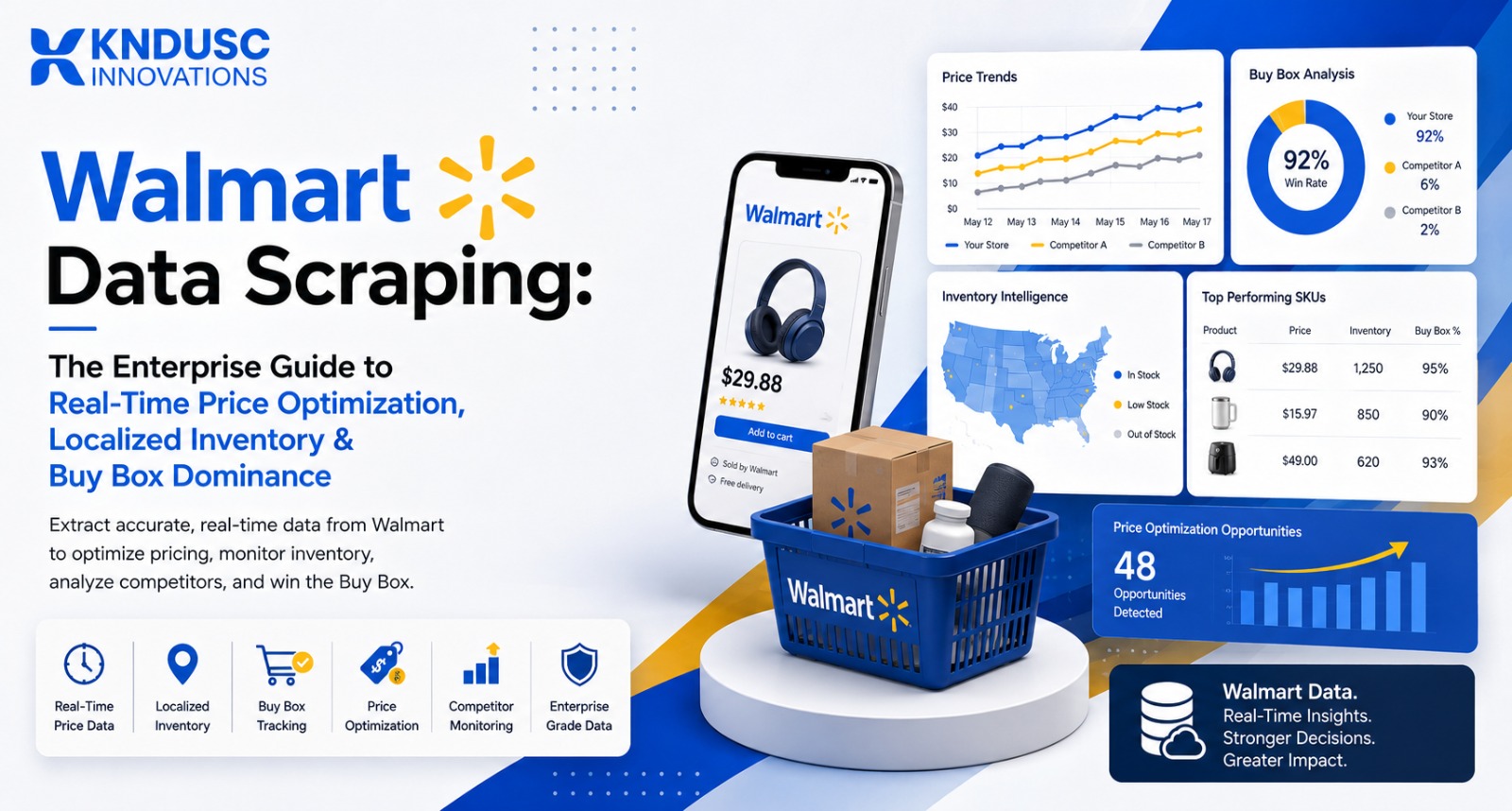
As e-commerce landscapes continuously shift, global retail brands, dynamic pricing teams, and market analysts face a highly competitive environment on major online marketplaces. Walmart has firmly established itself as a massive digital powerhouse, processing millions of daily transactions across both its first-party (1P) retail catalog and its rapidly expanding third-party (3P) Marketplace network.
For enterprises aiming to optimize digital shelf space, relying on manual auditing or lagging historical reports is no longer sufficient. Winning on this platform requires a continuous stream of structured data.
- Which third-party sellers are undercutting MAP compliance guidelines right now?
- How does product pricing fluctuate across different regional zip codes?
- What specific keyword trends are driving organic visibility within specific categories?
Extracting this information at scale requires navigating highly sophisticated technical infrastructure. In this comprehensive guide, we explore the precise mechanics of Walmart data scraping, break down the platform's advanced defensive layout, and explain how automated web data pipelines convert chaotic web pages into clean, actionable intelligence.
1. The Strategic Value of Extracting Walmart Data
Unlike platforms with a uniform national catalog, Walmart’s digital infrastructure is deeply tied to its massive physical retail footprint. This connection introduces unique operational variables that make real-time data scraping a vital competitive asset.
Localized Pricing and ZIP-Code Specific Inventory
One of the most complex elements of Walmart's web architecture is its localized fulfillment model. Prices and stock availability for grocery items, electronics, and home goods frequently alter depending on the shopper’s proximity to local store fulfillment centers or regional warehouses. Enterprise-grade web scraping allows companies to pass specific location parameters (such as targeted ZIP codes) to extract highly precise geographic pricing maps.
Buy Box Tracking and 3P Merchant Monitoring
The Walmart Buy Box dictates the vast majority of sales conversions for multi-seller listings. Third-party merchants constantly alter their pricing structures to algorithmically win this placement. By deploying custom scraping agents, brands can monitor the Buy Box around the clock, mapping out competitor behaviors and tracking unauthorized grey-market distributors instantly.
Walmart Fulfillment Services (WFS) Logistics Tracking
Items backed by Walmart Fulfillment Services (WFS) receive enhanced algorithmic priority and higher consumer trust badges. Scraping shipping badges and tracking delivery timelines across varying product lines gives cross-border merchants clear visibility into supply chain standards and competitor logistical strategies.
2. Core Data Fields to Target for Scraping
A scalable data harvesting framework must precisely capture specific technical attributes from both search engine result pages (SERPs) and product detail pages (PDPs):
| Data Layer | Specific Technical Target | Operational Value |
|---|---|---|
| Core Metadata | Product Title, Brand Name, GTIN/UPC Identifiers, Master SKU, Category Breadcrumbs | Standardizes product classification and automates internal catalog matching. |
| Pricing Insights | Current Retail Price, Strikethrough (Original) Price, Clearance Indicators, Unit Pricing | Feeds dynamic pricing algorithms to maintain margins. |
| Fulfillment Metrics | WFS Badge Presence, Est. Delivery Date, Free Shipping Threshold Status | Assesses fulfillment speed against competing logistics networks. |
| Seller Identification | Winning Buy Box Seller Name, Other Sellers List, Merchant Ratings | Flags unauthorized supply chain leaks and identifies key marketplace competitors. |
| Review Metrics | Total Review Counts, Average Star Value, Syndicated Review Flags | Tracks organic consumer sentiment and monitors product quality. |
3. The Technical Challenges of Scraping Walmart
Many in-house software development teams underestimate the complexity of building a resilient Walmart web scraper. Simple HTTP requests using basic coding libraries will almost instantly face severe operational roadblocks.
1. Advanced Anti-Bot Perimeters
Walmart deploys highly sophisticated web security frameworks at its network edge. These firewalls do not merely look at simple request rates; they analyze deep browser fingerprints, inspecting behavioral patterns, TLS handshakes, canvas tracking metrics, and WebGL elements. If a crawler presents an inconsistent or machine-like fingerprint, the system blocks access immediately with strict challenge screens or HTTP 403 errors.
2. Heavily Nested, Asynchronous JSON Layouts
Modern web pages on the platform render content dynamically using advanced JavaScript frameworks. Important product attributes—such as variation matrices (size, color, pack sizes) and live seller inventory—are often nested deep within script blocks or loaded via internal API calls after the initial page structure loads. A naive web crawler that only reads raw HTML code will fail to extract these hidden data structures.
4. Building an Evasion-Resistant Scraping Architecture
To maintain a consistent, unblocked stream of public retail data, developers must abandon rigid scraping scripts and implement a flexible, modern extraction mesh.
[Target: Walmart Marketplace Engine]
                ▲
                │  (Geo-Targeted Residential Proxies + Automated Fingerprint Blending)
[KNDUSC Scalable Data Infrastructure]
                │
                ▼  (Normalization & Automated QA Parsing)
[Structured Enterprise JSON Data Feed]
Premium Residential Proxy Management
Because pricing adapts dynamically to geography, your scraping infrastructure must utilize rotating residential proxy networks with precise city-level and ZIP-code level targeting. By routing data requests through authentic local residential service providers, web crawlers can view the exact product arrays presented to real local consumers while distributing traffic patterns safely.
Headless Browser Orchestration
Bypassing modern edge defenses requires utilizing advanced headless browser tools like Playwright or Puppeteer. These systems must be explicitly modified to simulate natural human behaviors—such as non-linear cursor scrolling, variable page pauses, and automated resolution of background network challenges.
5. Processing and Normalizing Raw Marketplace Data
Extracting raw text strings from web structures is only the first phase of an enterprise data project. Raw inputs must be parsed through an automated data cleansing pipeline before they can be utilized by business intelligence teams.
Universal Catalog Normalization
Different merchants list identical products using varied titles and descriptor terms. Data pipelines must isolate structural identifiers like UPC or GTIN codes, converting messy strings into standard relational database entries for smooth internal catalog matching.
Parent-Child Variation Mapping
A single item listing can feature dozens of individual variants across different sizes, colors, and bundle options. A high-quality extraction framework properly links these child configurations back to the primary parent SKU, ensuring that category analytics models accurately measure product depth without skewing inventory tallies.
6. Real-World Corporate Applications
- Retail Brands & Manufacturers: Monitor minimum advertised price (MAP) compliance across all third-party distributors to preserve brand value and catch unauthorized sellers instantly.
- Direct-to-Consumer (D2C) Merchants: Track high-velocity search queries and product categories to spot emerging consumer demand trends before sourcing inventory.
- Investment Groups & Funds: Analyze aggregate category health, pricing shifts, and fulfillment velocities to generate alternative datasets for macro retail forecasting.
7. Fully Managed Data Pipelines: Reducing Technical Overhead
Building and continually maintaining complex web scraping infrastructure in-house requires significant developer time, proxy expenses, and server management. Whenever a platform updates its front-end code, internal scripts break, causing critical gaps in data collection.
Partnering with data engineering specialists removes this operational burden completely through a fully managed Data-as-a-Service (DaaS) structure:
- Detailed Architecture Scoping: We map out your target variables, frequency requirements, and preferred delivery destinations.
- Risk-Free Sample Generation: We compile a customized sample dataset to your exact database specifications, ensuring complete formatting compatibility upfront.
- Automated Production Scale: Once validated, data collection scales seamlessly. Clean data is piped directly into your internal infrastructure via custom APIs, secure cloud storage buckets (AWS S3, Google Cloud Storage), or secure SFTP connections.
8. Conclusion: Drive Decisions with Real-Time Data
In a fast-moving digital retail environment, relying on incomplete data or static summaries places your business at an immediate disadvantage. Implementing automated e-commerce web scraping provides a real-time window into competitor pricing shifts, localized stock movements, and market changes.
Stop managing broken scripts, proxy configurations, and inconsistent datasets. Establish a reliable, fully automated data pipeline designed specifically around your enterprise analytical requirements today.